Get Premium
Dark mode theme is available exclusively for premium users. Learn more about the benefits of subscribing.
No fees, cancel anytime.

 Dark Mode Ad-Free Browsing Unlimited Content
 Ad-Free Browsing Unlimited Content Dark Mode
Join 1.2 million Panda readers who get the best art, memes, and fun stories every week!


Paintings can be far more complicated than they appear at first glance. The stories told by works of art are the stuff of novels. Here are a few of the stories behind famous masterpieces.
This post may include affiliate links.
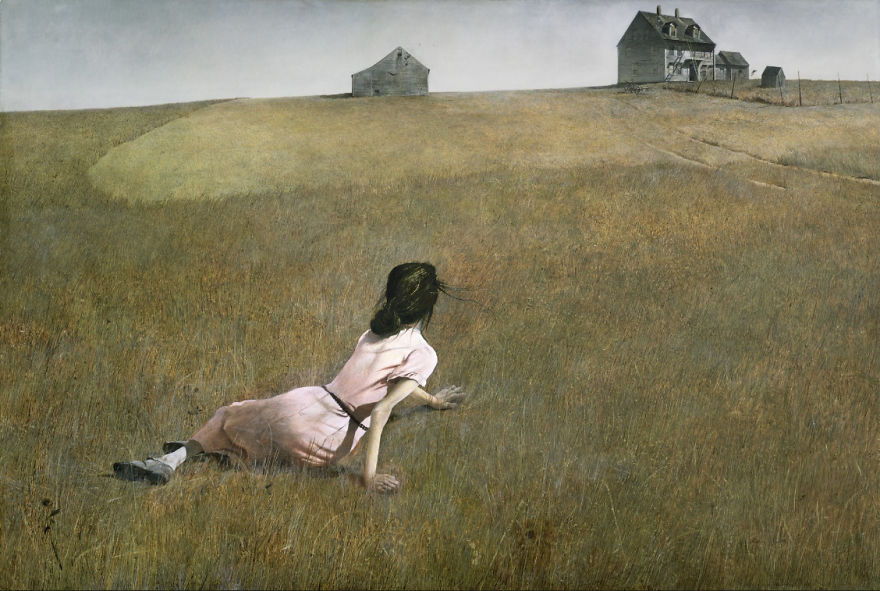
The faceless woman lying on the ground is Anna Christina Olson, the neighbor of Pennsylvania artist Andrew Wyeth. While the painting has all the hallmarks of a pastoral, it isn’t meant to be a romantic setting. Olson suffered from a muscle-wasting disorder, and Wyeth had seen her on many occasions dragging herself across the family homestead.


i actually think that is a very inspiring painting that teaches you to never give up. Also, you shouldn't say that is sad just because she's disabled. Don't be ableist.
Load More Replies... 
not hating but is that why her arms are kinda skinny? like i dont know what muscle-wasting disorder is or what it looks like...
I wonder what Christina thought of it/if she agreed to the portrait.

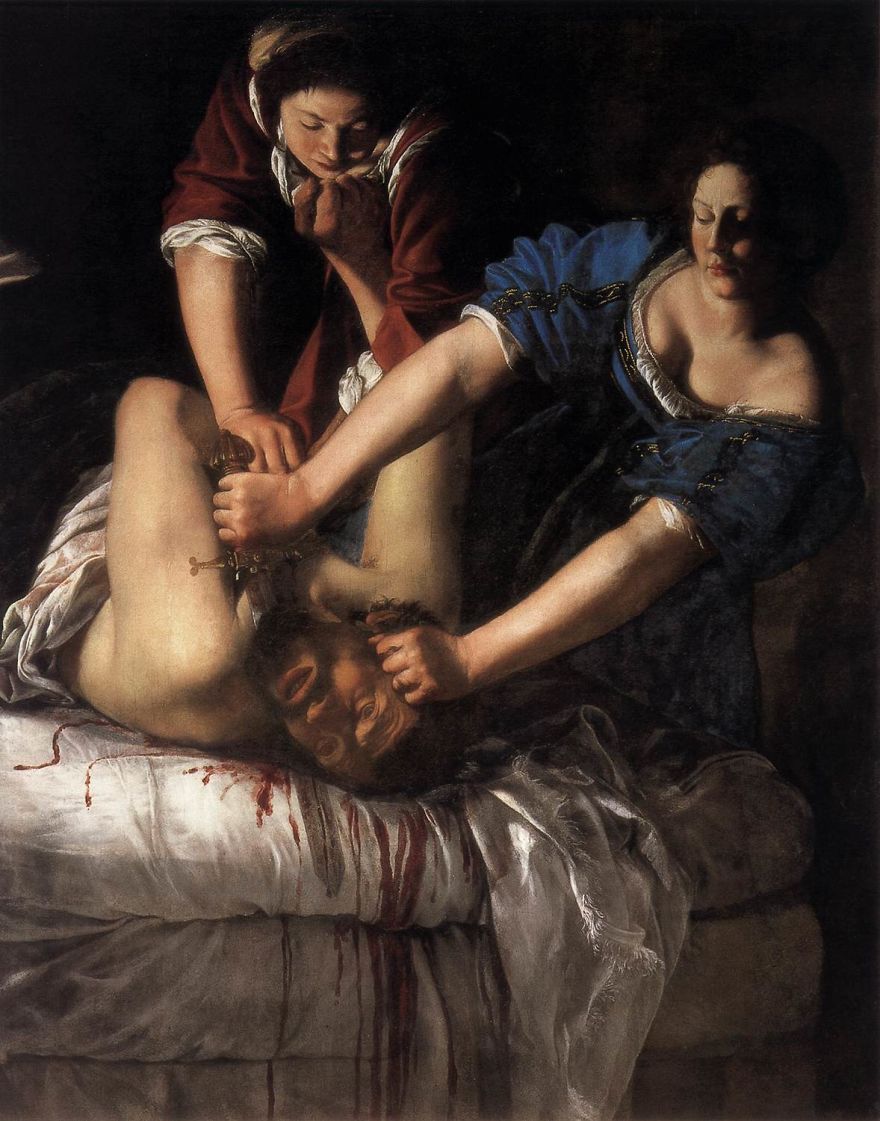
Raped at the 18, Baroque painter Artemisia Gentileschi angrily confronted her rapist in a public trial which ultimately set him free. She channeled her ensuing rage into her work, notably “Judith Slaying Holofernes,” which depicts determined Old Testament heroine Judith severing the head of the drunken Babylonian general.

This is one of the paintings "Judith Slaying Holofernes" she painted. One in 1611-1612 and the other in 1612-1621.

That's so interesting! I was just going to comment that I just saw this at the uffizi and it was a lot more bloody.
Load More Replies...
She did manage to tear a piece of his penis off, at which point he promised to marry her. When he doesn't, his father sues Tassi for rape.
Load More Replies...
I didn't know there was 3. Wow. Thanks for the info. I only know about the one with arterial spray.
Load More Replies...
The statment, that Gentileschi was raped by Tassi is not true. They have been a couple, but he didn't want to marry her. Her only choice to keep her Reputation was to sue him. Please stop the myth of the rape, read a book instead: Elizabeth S. Cohen, "The Trials of Artemisia Gentileschi: A Rape as History."
Cohen is frustrated that Gentileschi's art is read as rape trauma and that her art and the artist sexualized instead of viewed as an artist whose work was so gifted it was attributed to men. Gentileschi was tortured (thumb screws), and she did not recount because her reputation would be destroyed and honour lost if Tassi did not marry her and thus "erase" his crime. This does not mean she was not raped. Her father brought the case to trial to speed up the marriage, and the paintings Tassi stole from him. Tassi is also accused of having raped his first wife. Other theorists believe she painted Judith three times because she was infamous for the rape trial, and these subjects pleased and titilated her audience, who were thrilled by scenes of violence painted by a woman.
Load More Replies...Grant Wood was a national icon and leading exponent of regionalism. His most famous painting “American Gothic” depicts a Depression-era farmer and his weathered wife. Grant intended the couple to represent father and daughter; in reality, they were neither. The man holding the pitchfork was Wood’s dentist, Byron McKeeby, flanked by the artist’s sister, Nan Wood Graham.

So... they were meant to look like father and daughter, looked like husband and wife, but are neither? Cool.



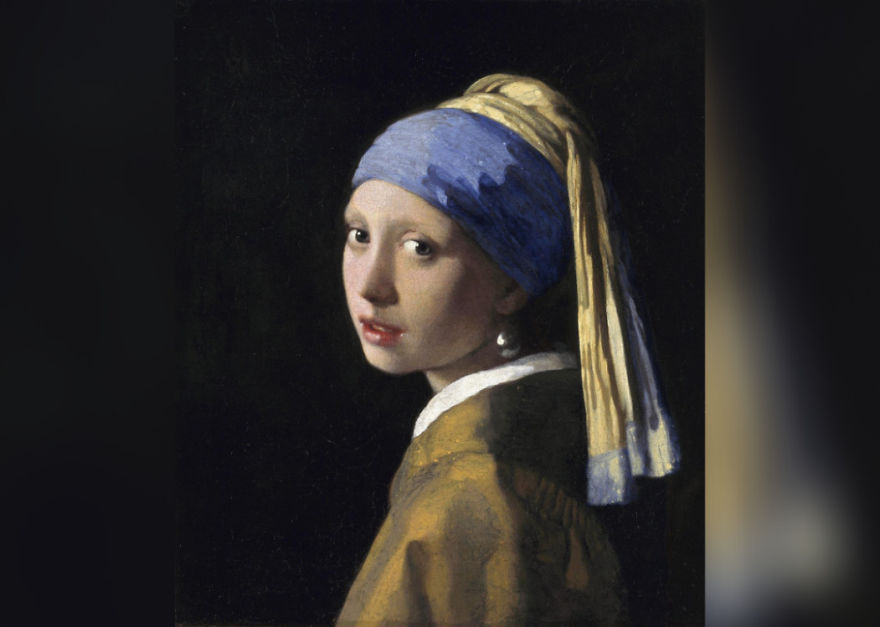
Little is know about the young woman depicted in Vermeer’s “Girl with a Pearl Earring.” It has been suggested that the girl was either Vermeer’s daughter or his mistress. While either may be the case, the image wasn’t intended to represent an actual person. The turban worn by the sitter indicates that the piece was intended as a “tronie”—an idealized image cloaked in exotic clothing.


I clicked on that and nearly jumped out of my skin!
Load More Replies...John Everett Millais painted directly from life whenever possible. Therefore, much of the foliage found in “Ophelia” can be found in Shakespeare's “Hamlet.” However, Millais didn’t subject his 19-year-old model, Elizabeth Siddall, to the elements; she reportedly posed for the artist in a bathtub full of water in his London studio.

The water was heated by candles. When the candles went out the artist continued painting her and she almost died from pneumonia.

That makes sense. The way her upper body is lifted looks like she's posed in a bathtub, not a brook.
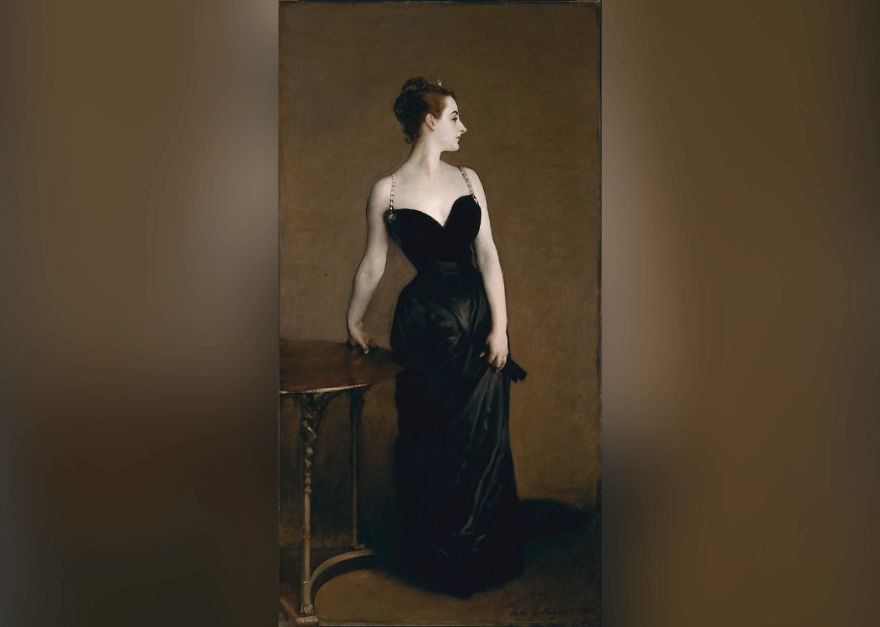
John Singer Sargent hoped this piece would make his career. However, the painting of Virginie Avegno Gautreau, the American wife of a French banker, outraged critics when it was first exhibited at the Paris Salon 1884. While overt sexuality was expected when the subject was a mythological heroine and tolerable when it was a prostitute moonlighting as an artist’s model, it was downright offensive when it applied to a woman of upper-crust Parisian society.

Note to self: once time machine is finished, go show 1884 Parisians a few random Instagram pics
Madame "X" became infamous after this painting. A second painting of her was mercilessly criticized because she as thin, or as young as in this portrait.


The right 'strap' of the dress was originally slipped down over the shoulder. Folks were horrified, so he moved it up.
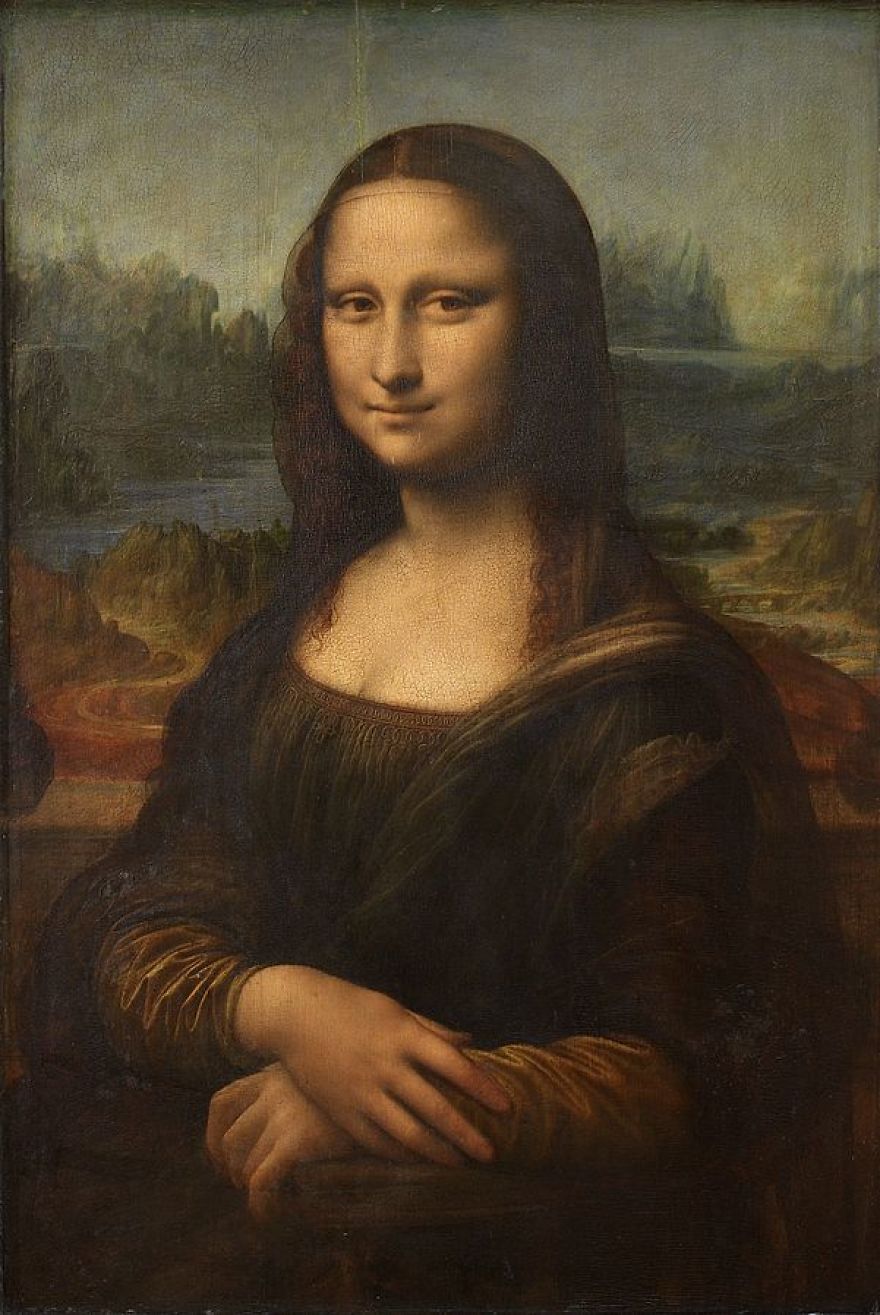
Traditionally, the Mona Lisa has been identified as Italian noblewoman Lisa Del Giocondo. Countless hypotheses have been put forth as to the explanations for her enigmatic smile. Extensive multi-spectral imaging conducted by Lumiere Technology in 2006 uncovered years of varnish revealed that her smile was originally broader than it appears today.


...and she isn't going tell anyone what it is...
Load More Replies... I have zero education in art (and normally even less interest). Obviously, there is a reason this painting is famous. However, just by looking at it, I couldn't tell you why. It moves me not one bit and holds no interest for me. All the others I've seeen so far make me realize that there are stunning paintings out there. Though why I need to look at them more than once or twice is beyond me.

She's smiling because she looked behind her and realized she was in Narnia.
Mexican artist Frida Kahlo’s work is infused with a deeply personal iconography and references a life of physical and emotional anguish. “The Two Fridas” portrays the artist before and after her painful separation from Rivera; on the left as a bride with an eviscerated heart, and on the right dressed in the traditional Mexican costume, she favored during happier times with Rivera.
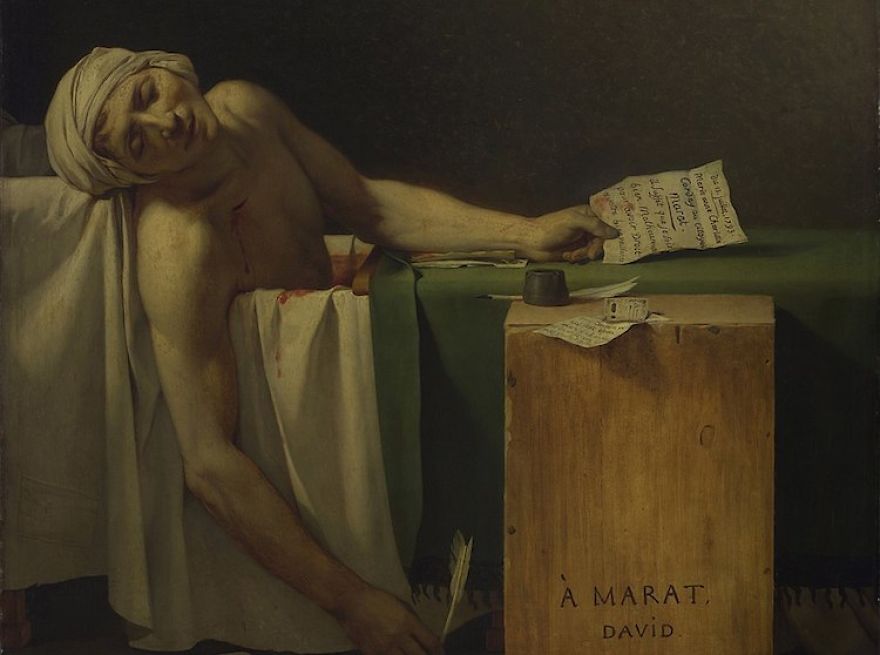
The pallid figure bleeding out in Jaques-Louis David’s masterpiece is Jean-Paul Marat, the French revolutionary stabbed to death by a political adversary while in the bath. David gravitated toward radical politics, aligning himself with the Jacobin ideologies of Marat and Maximilien Robespierre. In post-revolutionary France, he rose to the position of court painter under Napoleon Bonaparte.

I don't feel sorry for marat. I feel sorry for Charlotte Corday... 4 days later they executed her with the guillotine...
Marat was incredibly ugly, but David changes his features to make him look like a saint who died for the people--note the simple desk he writes on and the repaired sheet. Marat practically lived in the bath because he had a horrible skin condition that made his skin the colour of yellow cheese (which is also why his head is wrapped).

It should be noted that these were actually old time "crime photos." When Jack the Ripper was in full swing, painters were brought into the crime scene to document it for a possible future trial. Can you imagine how long that took?
This is propaganda meant to make Marat into a saint who died for the revolution. David changed the letter from Charlotte Corday Marat is holding to make look Corday look like treacherous.
Load More Replies...Not only was the iconic “Washington Crossing the Delaware” painted almost 75 years after the Revolutionary War, but it was also painted by a German artist—Emanuel Leutze—in Düsseldorf. Leutze had spent time in the U.S. and painted the scene with the hope that it would inspire European revolutionaries.
The couple is thought to be Giovanni di Nicolao di Arnolfini, and his wife, Costanza Trenta, wealthy Italians living in Bruges, West Flanders. The unusual composition begs several questions. Does the painting celebrate the couple’s wedding or some other event? Was the bride pregnant or simply dressed in the latest fashion? And what are the mysterious figures depicted in the convex mirror? The unorthodox placement of van Eyck’s signature directly above it suggests one of the men may be the artist himself.

Many portraits of this era portrayed women like this to represent good luck and prosperity though they weren't actually pregnant.
All these questions are already answered by art historians. Yeas, a marriage, no, not pregnant just fasion. Yes, the men in the Mirror are the witness, yes one of them is van eyck. Over the mirror is written "Jan van eyck was here" to witness the marriage
I agree. This guy tried: https://www.youtube.com/watch?v=4JkIs37a2JE
Load More Replies... This painting is all about Arnolfini's wealth--the very expensive wool and fur dress, the bed (a Ferrari), the mirror, the bride (from a wealthy, respected family), even the little dog cost a fortune.

I read that it may have been in memory of the wife, who died in childbirth. The candles on her side of the candelabra are extinguished, and her hand is slipping away

are those shoes to the left of him? They look like ancient Dr Scholls.

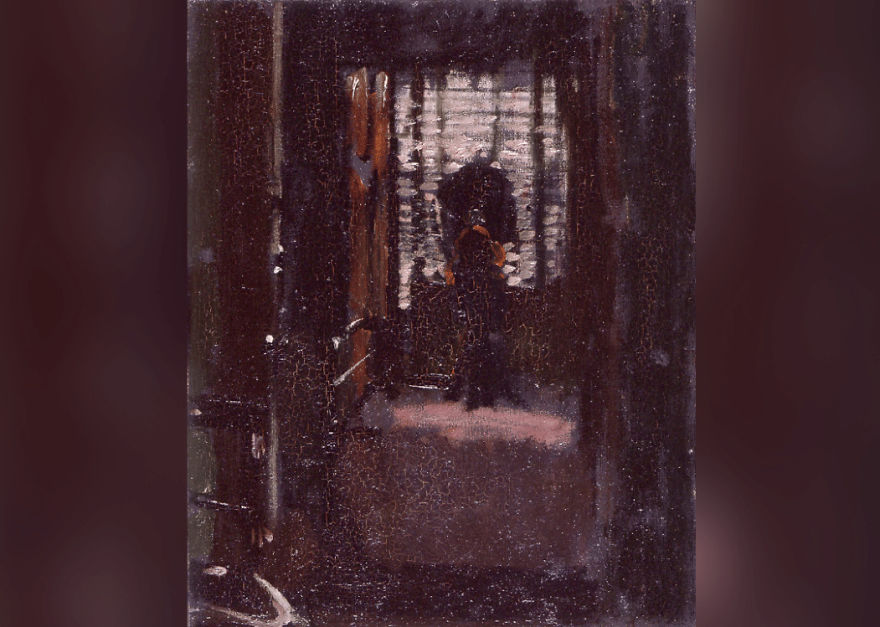
Walter Sickert, noted for his moody portraits and dimly lit domestic interiors, may have harbored a secret darker than his paintings. It has been argued that disconcerting works such as “Jack the Ripper’s Bedroom” and “The Camden Town Murder” may reflect some connection between the artist and the grisly Whitechapel butcher—either as an accomplice or the murderer himself.

The writer Patricia Cornwell is convinced that Sickert is indeed the Ripper himself, having written a book and fronted a tv show explaining her theory. But there is diffident evidence to rule him out completely.

He lived in London, at the time the murders were committed, at a time where photographs in newspapers were showing the victims faces... Is it a surprise that it would crop up in his work? It was also the most sensational piece of news of the 1880s.
Load More Replies... Again..consider that many of these grim paintings were just the "crime scene" photos of the day. Photography was quite expensive and it was cheaper for them to bring in what was the equivalent of a "sketch artist" to preserve the crime.
The works of the Belgian painter René Magritte are frequently head-scratchers, and “The Son of Man”—a self-portrait of the artist with his face obscured by a giant apple—is no exception. The apple was one of the artist’s favorite motifs, but its meaning is uncertain. The title chosen by Magritte is perhaps more illuminating, referencing Jesus Christ. Some critics have called the piece a surrealist interpretation of the transfiguration of Jesus.

I always thought that it was referencing the fruit (usually thought of as apples) Adam and Eve ate in the garden of Eden, making them unholy and 'a son of man' instead of god



He was a surrealist. He played around with physics a lot and usually, his titles had nothing to do with the painting itself, so this one is unlikely.
Magritte was an agnostic, so why would Magritte see himself as Jesus? And why would Jesus be considered the son of man? The Bible never references him as such and there are several references of sons of God and daughters of man.
In the Gospels Jesus uses the term 'Son of Man' in reference to himself more than any other term. I agree with the comment regarding this being surrealism, sometimes the artist is just having fun, sometimes it is something else. It is for you to discover.
Load More Replies...It is a tale straight out of Greek mythology. Polyphemus, the giant that is sporting the solitary eyeball, peers over a rocky outcropping at the object of his desire—the nymph Galatea. Derived from Homer’s “Odyssey,” the tale was a popular trope among French symbolists, including Redon’s contemporary, poet and painter Gustave Moreau.









































 No fees, cancel anytime
 then open in external browser


 and click "Open in External Browser"