Get Premium
Dark mode theme is available exclusively for premium users. Learn more about the benefits of subscribing.
No fees, cancel anytime.

 Dark Mode Ad-Free Browsing Unlimited Content
 Ad-Free Browsing Unlimited Content Dark Mode
Join 1.2 million Panda readers who get the best art, memes, and fun stories every week!


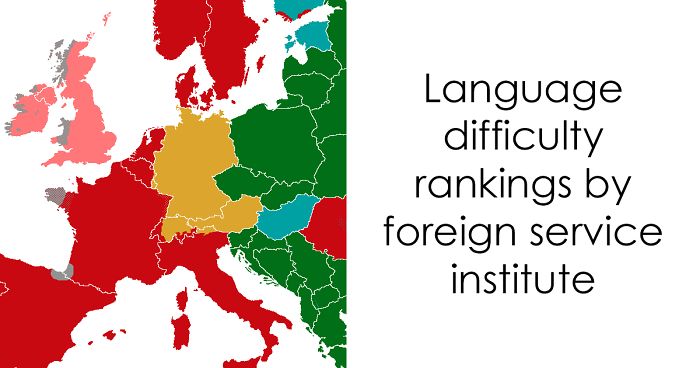
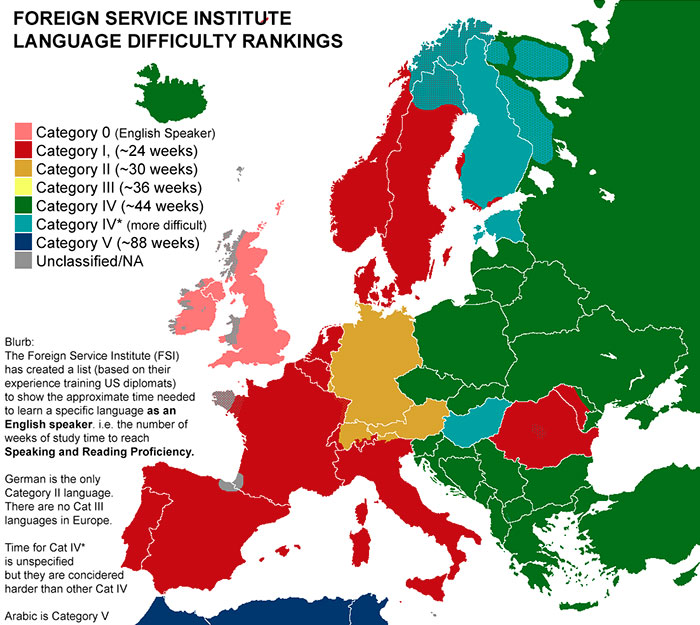
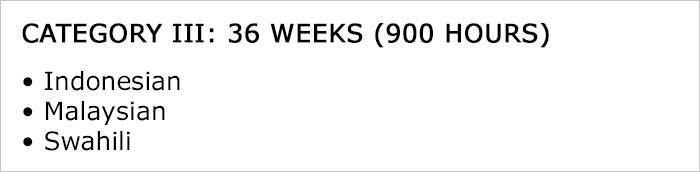
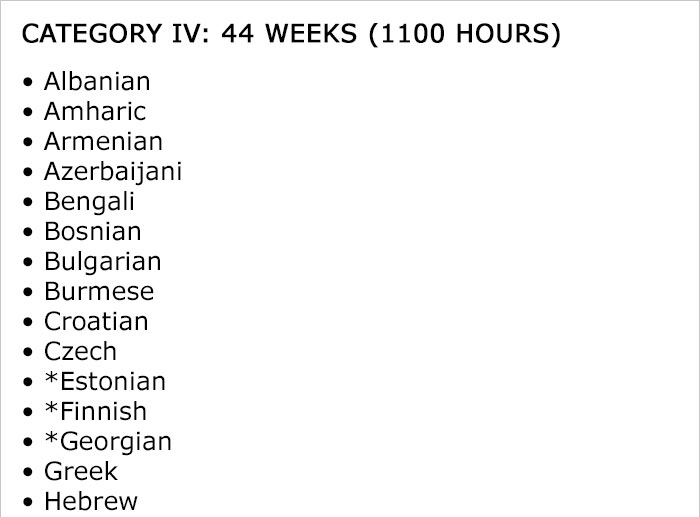
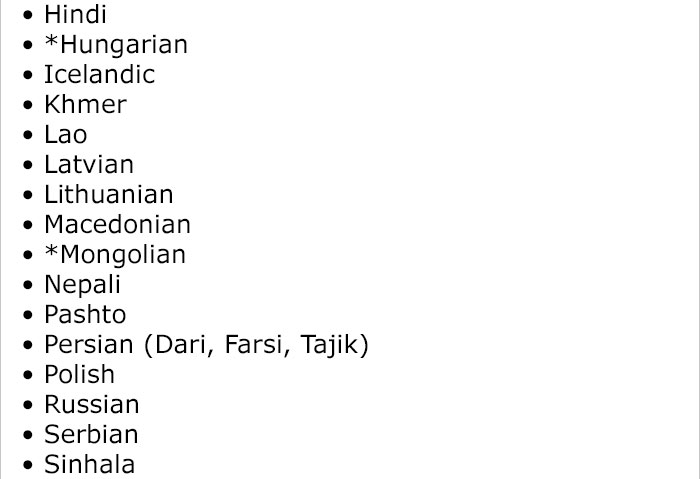
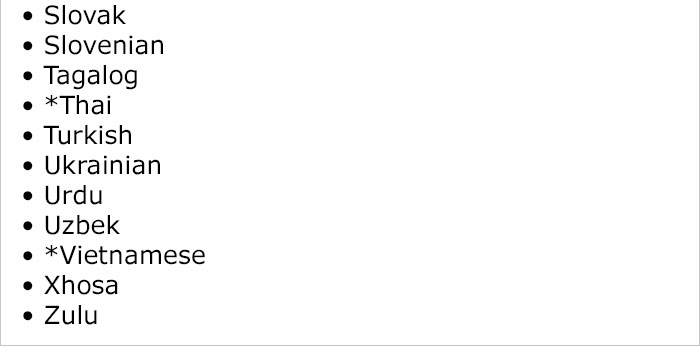
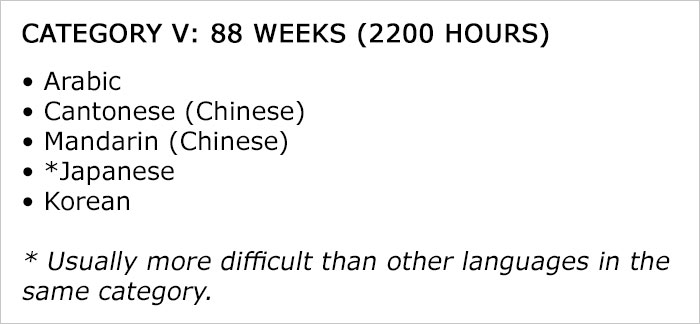
Interested in learning a foreign language, but need one that’s easy and time-efficient to pick up? The Foreign Service Institute has done the handy task of sorting major languages around the world into 5 categories of difficulty according to their differences from English, and Reddit user Fummy has translated that data into a color-coded map to make it all simpler.
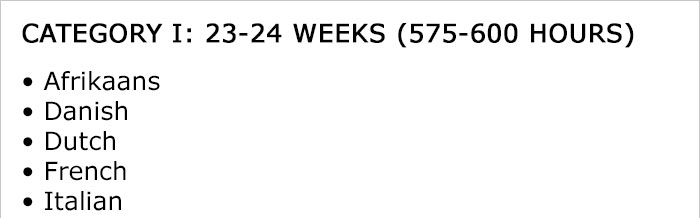
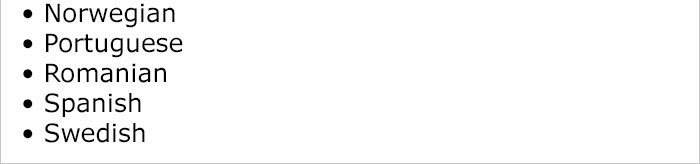
The Romance languages, based mainly on Latin, are among the most approachable, and include French, Spanish, and Italian. Tongues like Dutch, Danish, and Swedish share common roots with English, meaning half your work is done already if you choose to learn them. You’re looking at about 6 months of study to achieve proficiency in any of these ‘Category I’ languages.
Are you leaning further towards Japanese, Korean, or Arabic? Get ready for a mammoth 2 years of practice, one of which should be in-country. These are 3 of the languages that make up the fearsome ‘Category V,’ as they’re about as different from English as black is from white.
Scroll down to see all of the statistics for yourself, and if you’re ready to embark on a linguistic journey, you can find free online courses straight from the FSI, the Defense Language Institute, and the Peace-Corps here.
364Kviews
Share on Facebook


monia monica, only very small parts of belgium or luxembourg speak german (which are very small countries already), and in switzerland they it's swiss- german, which is close to german- but still not german. (Like italian and spanish are close- but still not the same). So no, i would also say that it is not worth the trouble;) i love my language, but wouldn't recommend to study it as much as for example french..
Load More Replies...
They are tough for being so far removed from English, but there is logic in Japanese and Vietnamese that I wish would carry over. For example in Vietnamese, everything is separated with a space between each syllable, and every letter can only be pronounced one way as it's written, so you can see a word for the first time and immediately know how to say it. In Japanese, they are very economical in their words, in that they don't use unnecessary grammatical filler, and they don't invent unnecessary synonyms. For example, English "I am scared," becomes "scared" in Japanese; you can assume who the subject is in context. But in English one wouldn't say "I am scared," because we are taught that it is too simple, so we have to say "I'm terrified/frightened/in fear/shaking in my boots," to add flair to what is still a simple expression. Japanese also takes to only one pronunciation for each letter. A E I O U is "ah" "eh" "ee" "oh" "oo" with the only exceptions being consistent.

Tha Japanese grammar is very structured and relatevely easy to understand, but you forgot about kanji - hell of a work to remember how to read even if you know the meaning. All kanji have at least 2 readings and can be used at the same time - my favourite example is Sunday - in kanji 日曜日 - and pronounsation is - Nichiyōbi. The same kanji 日 have different readings within ONE word.
Load More Replies...
When you see someone say that Polish is sooo difficult, you can be 99% sure this person is Polish.

Not sure about the infographics of this. Who else thinks that red should stand for had to learn language and green for the opposite?

I am a fluent Finnish speaker. Sadly this is quite useless language to learn unless you live in Finland. Most Finnish people can speak English so for the tourists there is no need to learn Finnish.

But speaking finnish is your superpower. If you can learn finnish, you can learn anything.
Load More Replies...
I dunno, I've majored in linguistics and I'm fluent in 4 languages (2 native, 1 acquired throughout adolescence, the 4th acquired in adulthood). The time and difficulty it takes to learn a language depends on your starting perspective and the environment. To a native English speaker, for example, the time to learn Italian will differ from the time needed for a Spanish native speaker; someone speaking only one single language also is not in the same position as someone who grew up bilingually; someone living in, for example, Germany will learn Japanese slower than someone learning it right there in Japan (but not neccessarily) and so on. Not to mention individual affinities, someone will catch a new language easily, someone else will need to work harder. This info needs more background.
Well the article clearly states it’s from the perspective of a native English speaker, not a native Mandarin speaker. And since English has more similarities with Germanic and Scandinavian languages (partly due to historical influences), those languages will be easier and quicker to learn for a native English speaker than let’s say Arabic or Russian or Thai.
Load More Replies...
I've been teaching Norwegian for foreigners for some years now, but I never met a English-speaking person who learned Norwegian fluent I six months. Good luck learning the other languages. Learning languages take time...


Probably only the most widely spoken languages are mentioned. The list would otherwise be too long...
Load More Replies...
How about Luxembourgish? I know we are a small country, but despite that fact we have have our own language. I need to clarify as well that Luxembourgish is not a German dialect, it is a language on its own, and unfortunately a lot more difficult to master.
monia monica, only very small parts of belgium or luxembourg speak german (which are very small countries already), and in switzerland they it's swiss- german, which is close to german- but still not german. (Like italian and spanish are close- but still not the same). So no, i would also say that it is not worth the trouble;) i love my language, but wouldn't recommend to study it as much as for example french..
Load More Replies... They are tough for being so far removed from English, but there is logic in Japanese and Vietnamese that I wish would carry over. For example in Vietnamese, everything is separated with a space between each syllable, and every letter can only be pronounced one way as it's written, so you can see a word for the first time and immediately know how to say it. In Japanese, they are very economical in their words, in that they don't use unnecessary grammatical filler, and they don't invent unnecessary synonyms. For example, English "I am scared," becomes "scared" in Japanese; you can assume who the subject is in context. But in English one wouldn't say "I am scared," because we are taught that it is too simple, so we have to say "I'm terrified/frightened/in fear/shaking in my boots," to add flair to what is still a simple expression. Japanese also takes to only one pronunciation for each letter. A E I O U is "ah" "eh" "ee" "oh" "oo" with the only exceptions being consistent.
Tha Japanese grammar is very structured and relatevely easy to understand, but you forgot about kanji - hell of a work to remember how to read even if you know the meaning. All kanji have at least 2 readings and can be used at the same time - my favourite example is Sunday - in kanji 日曜日 - and pronounsation is - Nichiyōbi. The same kanji 日 have different readings within ONE word.
Load More Replies... When you see someone say that Polish is sooo difficult, you can be 99% sure this person is Polish.
Not sure about the infographics of this. Who else thinks that red should stand for had to learn language and green for the opposite?
I am a fluent Finnish speaker. Sadly this is quite useless language to learn unless you live in Finland. Most Finnish people can speak English so for the tourists there is no need to learn Finnish.
But speaking finnish is your superpower. If you can learn finnish, you can learn anything.
Load More Replies... I dunno, I've majored in linguistics and I'm fluent in 4 languages (2 native, 1 acquired throughout adolescence, the 4th acquired in adulthood). The time and difficulty it takes to learn a language depends on your starting perspective and the environment. To a native English speaker, for example, the time to learn Italian will differ from the time needed for a Spanish native speaker; someone speaking only one single language also is not in the same position as someone who grew up bilingually; someone living in, for example, Germany will learn Japanese slower than someone learning it right there in Japan (but not neccessarily) and so on. Not to mention individual affinities, someone will catch a new language easily, someone else will need to work harder. This info needs more background.
Well the article clearly states it’s from the perspective of a native English speaker, not a native Mandarin speaker. And since English has more similarities with Germanic and Scandinavian languages (partly due to historical influences), those languages will be easier and quicker to learn for a native English speaker than let’s say Arabic or Russian or Thai.
Load More Replies... I've been teaching Norwegian for foreigners for some years now, but I never met a English-speaking person who learned Norwegian fluent I six months. Good luck learning the other languages. Learning languages take time...
Probably only the most widely spoken languages are mentioned. The list would otherwise be too long...
Load More Replies... How about Luxembourgish? I know we are a small country, but despite that fact we have have our own language. I need to clarify as well that Luxembourgish is not a German dialect, it is a language on its own, and unfortunately a lot more difficult to master.






































 No fees, cancel anytime
 then open in external browser


 and click "Open in External Browser"















257
109