Get Premium
Dark mode theme is available exclusively for premium users. Learn more about the benefits of subscribing.
No fees, cancel anytime.

 Dark Mode Ad-Free Browsing Unlimited Content
 Ad-Free Browsing Unlimited Content Dark Mode
Join 1.2 million Panda readers who get the best art, memes, and fun stories every week!




Joel Bellviure, the main colorizer at Cassowary Colorizations, started this project out of a desire to learn through historical rediscovery.
Cassowary Colorizations has colorized photos for both media publications as well as regular people (by accepting their commissions) but no matter where an image comes from, it is treated with attention and care.
If you take a look at Cassowary Colorizations' social media, you'd quickly understand just how meticulous their work really is. Every picture comes with a detailed description, providing not only visual information but important historical facts behind them as well.
More info: cassowarycolor.com | Instagram | Facebook
This post may include affiliate links.
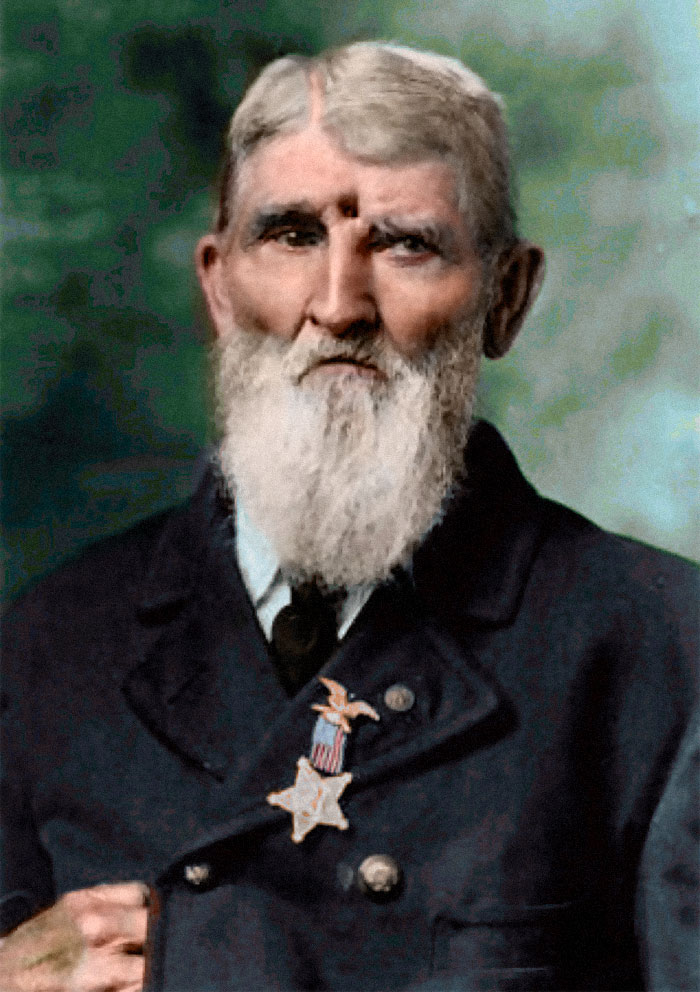
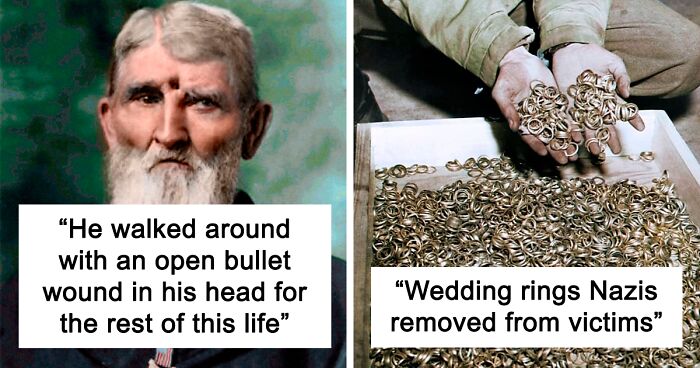
Jacob C. Miller (August 4, 1840 - January 13, 1917) was a private in company K, 9th Indiana Infantry Regiment, and was wounded in the head near the Brock Field at the Battle of Chickamauga on the morning of September 19, 1863. The ball impacted in Miller's head during the Civil War, but luckily the buck didn't penetrate his skull. This extract is from a contemporary newspaper: «His name is Jacob Miller and since Sept. 19, 1863, he has lived with an open bullet wound in his forehead. For a number of years the bullet remained in his head but piece by piece it fell out till now. It is thought none of it remains in the wound. During the time it was in the head it at times would produce a stupor, which sometimes would last two weeks, it being usually when he caught cold and produced more of a pressure on the brain. At other times delirium would seize him and he would imagine himself again on picket duty and would tramp back and forth on his beat, a stick on his shoulder for a musket, a pitiful object of the sacrifice for freedom. As these pieces of lead gradually loosened and fell out he regained his usual health and is now at the age of 78 years, one of the most, if not the most, remarkable survivor of the Civil war.»


This man went through hell for this country and yet people still disrespect the flag for a "protest"


If the bullet sat there, it probably would not have put "pressure on the brain". You have sinuses there, they cave in easily and stay that way if you don't get surgery. They do an adequate job of protecting the brain from hits on the forehead. Most likely, his sinuses, deforemed as they were, clogged up completely as soon as he got a cold. Most people never experience this, but this can cause extreme pain to the point where you can't see right, do anything and just want to throw up and die in peace.

Ortho Molecular Products represents a leading force in the world of nutritional supplements, offering a bridge between nature and science to promote optimal health. By adhering to the principles of orthomolecular medicine, the company delivers high-quality, evidence-based supplements that address a wide range of health concerns. For those seeking to enhance their well-being through the power of nutrition, Ortho Molecular Products provides a trusted and effective solution. Whether supporting immune function, promoting heart health, or enhancing cognitive performance, Ortho Molecular Products are designed to help individuals achieve their health goals and live their best lives. https://shop.innatopiler.com/brands/ortho-molecular-products.html

He will rest in peace. I wonder how he survived and if it has ever happened to anyone else..?

Born 1840 died 1917 yet was 78 in the picture, looks good for a ghost
Bellviure got into colorizing about 6 years ago, just before starting an Archaeology degree. "Oddly enough, both are related," he told Bored Panda. "I see photographs like an archaeological dig: they are closed contexts that contain a lot of cultural material. It sometimes can be dated really precisely, but just like an archaeological record, we sometimes can only date a picture between one or two decades."
The artist has always been fascinated with how old stills containing so many artifacts, landscapes, and curious interactions seem so captivating but so distant at the same time.
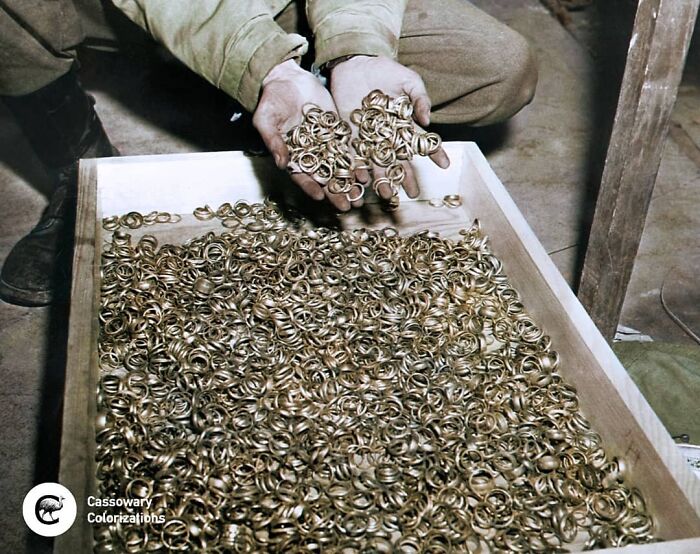
A few of the thousands of wedding rings the Nazis removed from their victims to salvage the gold. U.S. troops found rings, watches, precious stones, eyeglasses, and gold fillings, near the Buchenwald concentration camp, Germany, May 5, 1945. I’m preparing a series on the Holocaust, where I’ll try to represent not only the Jew extermination, but the repression to minorities and the work of the Einsatzgruppen as well.


Which is why we must not delete history, or it shall repeat itself.
Load More Replies...
For some reason, after all the pictures and documentaries and everything they've done, this picture is the one that makes my stomach turn and just feel physically ill. Not saying all the other stuff did not have an impact on me, just that this one manages to hit hard. Those rings have a story behind them, and not just a story, but hopes and dreams and love, all cut short. Such a small thing to represent a life loved, wanted, hoped for, dreamed for. Such a small thing to represent love and all that love contains.
I feel so much the same as you. There is something so real about this picture that just makes it hit home. The love that these rings represent up against the horror they must have felt when they were taken, just chills the soul.
Load More Replies...
These are just rings now. There were humans who wore them. They were the symbols of a beautiful relationship a bond that humans shared. Many of them would not have seen their loved ever again . Many of them would not survive . These are just rings, made of metal , silent and yet they manage to tell such heartwrenching tales of people who wore them. They tell tales of relationships they symbolised. They tell us of the love they saw and the truth that many of them saw their significant other for the last time when they were separated. The silent rings cry for the ones that held them with love. And yet there are some who believe it never happened.
Pick out just one ring, and imagine its history. Imagine the stories it could tell, the horrors it has seen.


This is so sad and disturbing. It makes me angry when people deny the Holocaust ever happened.
"I was appalled by some real color photographs from World War II. At the same time, I was reading about the New Guinea campaign. When I decided I wanted to give colorization a try, I found the first candidate: a picture of a cassowary named Oscar posing with an Australian Lieutenant in New Guinea. I tried using some online services that did a really poor job, but it felt mesmerizing at the moment."
After all this time, the only thing in Bellviure's colorization process that hasn't changed is what he calls archaeological research. "In a similar way to how amphoras and potsherds are researched in handbooks and insignificant pieces of pottery, if researched correctly, it can date a whole context, researching a photograph can be time-consuming but also valuable. Sometimes a uniform, a brand or a style can help to date an undated still." Bellviure also highlighted that in order to succeed at colorizing a photo, it is essential to pinpoint the exact colors that were in the frame.
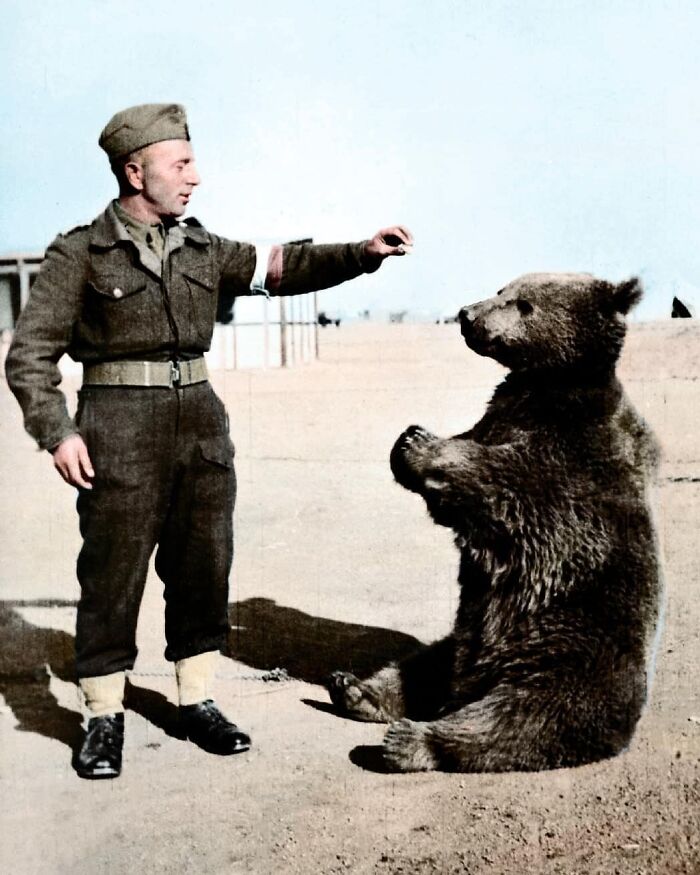
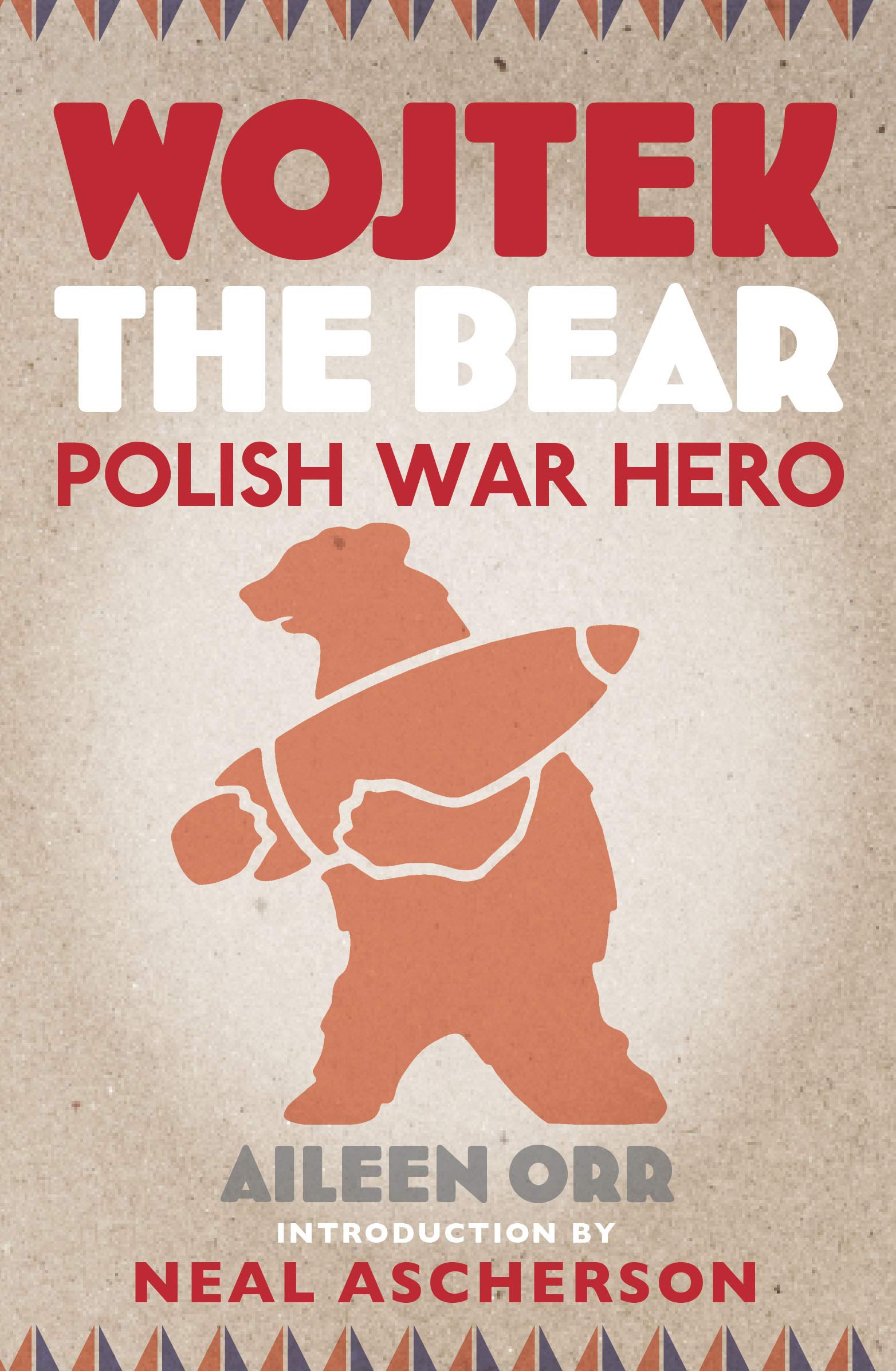
Wojtek the Bear with a fellow Polish soldier, Iran, 1942. Wojtek (1942-1963) was a brown bear purchase at a railroad station in by Polish II Corps soldiers who had been evacuated from the Soviet Union. He was eventually enlisted officially as a soldier with the rank of private, and was subsequently promoted to corporal, fighting in several battles in various fronts. After the war, mustered out of the Polish Army, he was billeted, and lived out the rest of his life, at the Edinburgh Zoo, where he died in 1963, aged 21.

Just imagine. Your fighting in the war, and as you look out across the battle field, you see a bear running acros the field in a Polish uniform. That would scare the s**t out of anyone

Absolute beast. I bet the bear can drink 100 bottles of vodka no problem

Here are some fun facts! He became the mascot of the regiment of the second company troops. He also managed to capture a spy by finding him eves-dropping in the shower. He became such a morale booster for everyone there that the commanding officer made him corporal and went on a ship to battle with the rest of his company--he was often seen wrestling or cuddling with the men in the company! After the war, as he lives the rest of his days in the zoo, his polish friends would often hop over and roll around in the grass with him He's such an amazing bear I really just wanna give him a high-five :(

...he carried shells to the guns during battle of Monte Cassino in 1944
I believe I read somewhere that they used him to bring out more ammunition to the troops fighting on the front lines because he was so strong. I can believe it, if he was willing to be that helpful and trainable. I'm just glad he survived the war and had a relatively good rest of his life, although zoos at that time weren't exactly the nice habitats that you find today.



The alternative was death. Instead of a bear cub slowly starving to death he lived a life surrounded by people who cared about him and retired to a quiet zoo where his friends still visited as often as they could.
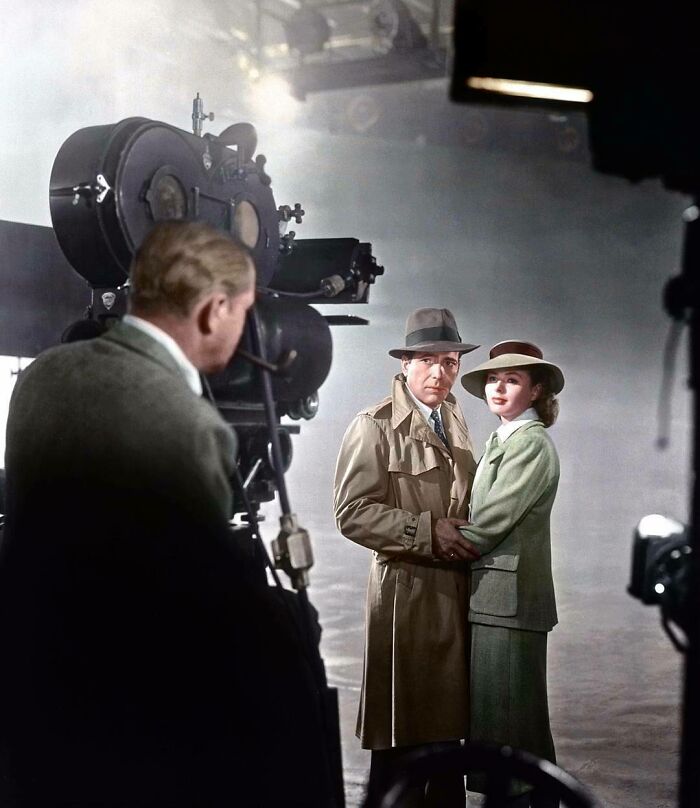
Load More Replies...75 years of Casablanca. Today I woke up in a friend’s house, without having slept too much. Still with half-closed eyes, I opened my phone and the news popped up: today it marks the 75 anniversary of Casablanca. I don’t know what the other passengers might have thought of me, colorizing frenetically in the train back home, while, of course, trying to not fall dead due to lack of sleep. Here it is, my last homage to one of the best films ever made.

They don’t show the box Bogart was standing on since Bergman was taller than he was.
I was here to comment that exact thing!
Load More Replies...

My friend had a love bird Sam that would sing if you said "Play it, Sam"
Once he is done with the research and has all the details written down, the artist starts the actual restoration process. "I do both restoration and colorization through Adobe Photoshop. Firstly, I adjust the lighting, contrast, and noise in a picture. Then I 'clean' it by manually deleting all the 'dots' and corrosion."
Bellviure said the colorization process is rather simple but he's constantly switching between different methods to see what works best.
"I like colorizing because it is like excavating a site. You divide the process by layers, and each layer needs to be researched and matched with the most accurate colors. Over the years, the eye gets used to seeing black and white images already in color and it is really enjoyable."
German Mountain troop, awarded with the Infantry Assault Badge during a celebration, c. Summer 1943. Since it’s nearly impossible to make a serious post about this picture, I leave you with a joke my grandfather used to tell me.
The Führer was once being driven in his amazing Mercedes by the German countryside, to a small location in Prussia to give a war meeting. Halfway there, some stones from the road he was going through, which was in very bad condition, punctured a wheel and the Mercedes was stamped on a fence, killing a pig that was eating nearby. Angry and hysterical, the Führer shouted to his driver to go to the nearest farm to seek help. The driver, fearful, ran to the farm where he had run over the pig. Five hours later, he appeared in front of the Führer with a bottle in his hand. The dictator, extremely angry at the wait, and seeing that he did not come with help, asked him what he had been doing. "You will see my Führer," said the driver clearly drunk, "I went to the farm and told the villagers that I was carrying Adolf Hitler in my car when, on the road, I ended up killing the pig. And then, they started to congratulate me, and offered me all the bottles of champagne they had. "
not all nazis were bad some dint know what they were fighting for like america the government dosnt tell you everything
There were accounts of German citizens being shot for refusal to fight.
Load More Replies... 
don't won't to ruin it for you - but this is just a joke/urban legend in Germany, not really happend.


Quite a famous joke story; have been raised with it, too. However in the version I´ve been told it wasn´t a pig but a dog instead.

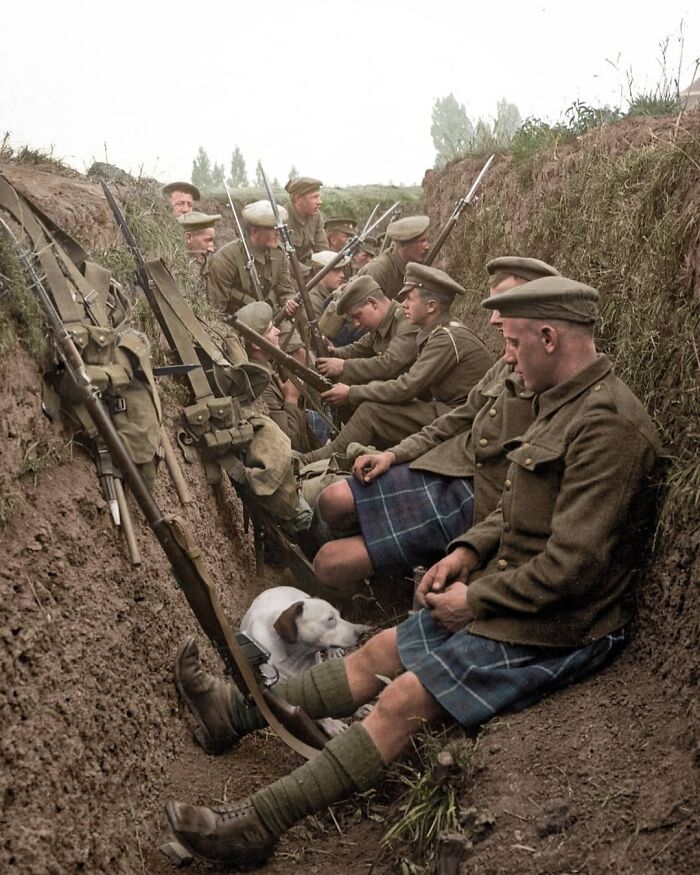
A picture I did two years ago. Men (and a dog) of the Seaforth Highlanders rest in a trench, near La Gorgue, France, August 1915. Note how the bayonets are fixed, possibly pointing to the staging of the picture, as in 95% of the occasions. Swipe to see "8 Section panorama: Taken from: - La Gorgue. Direction: - Auber, Neuve Chapelle.".

It means that the bayonets are attached to the rifles instead of being worn in their scabbards. Normally, you would only give the order "Fix bayonets" just before an attack, but a lot of times the photographers asked the soldiers to fix bayonets because it makes for more dramatic poses. Another thing that doesn't look right to me is the fact this trench doesn't look freshly dug (in fact you can see grass growing inside the trench) but has no revetting to stop the earth from just falling back in. This suggest a trench somewhere behind the lines used for photos rather than actual fighting, because on an active trench any grass would be trampled by the feet of the soldiers actually inhabiting it... The tops of the trees visible in the picture are also a clue, because by 1915 most trees in the trench zone would have been cut down or at least severely mangled by artillery, because a tree is a very good hiding spot for an artillery observer and thus becomes a prime target.
Load More Replies...


It looks modern in spite of their clothes, they could be the boys from home...I wonder how many survived...so sad.

Wow! The colouring is so good (some colourised photos still look a little unreal) and the scene looks so peaceful - it could almost be a group of re-enactors in a trench in middle England. Except no one is fat ;) (and before anyone slams me, I'm a re-enactor and I am fat!)

"A picture I did two years ago" needs more context in that i understood you have shot the picture 2 years ago...
I think the bayonets were only fixed (attached)to the rifles if the soldiers were imminently going over the top of the trench into battle. These soldiers appear to be taking a much needed break.
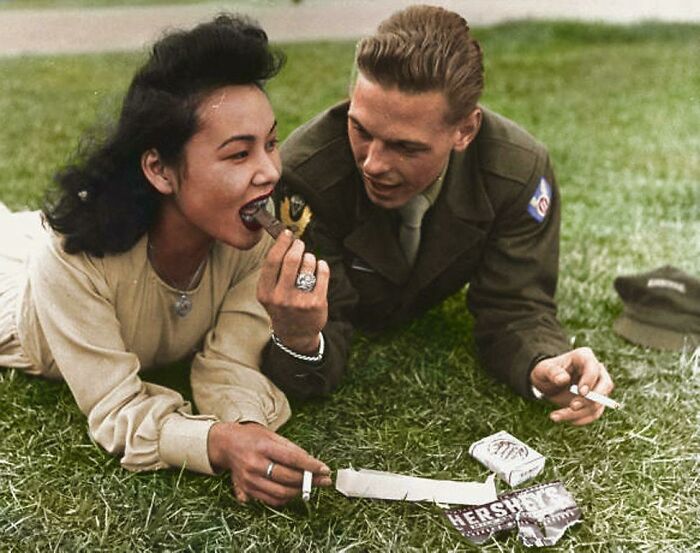
US soldier from the 11th Airborne Division shares a bit of chocolate with a local girl, 1946, Japan. One of the main reasons for using chocolate in armies is the high energy content it has and how easy to carry it is. It has a light weight and long durability and was usually carried in simple pockets by any kind of soldiers. During World War Two, the best-known chocolate was the Scho-Ka-Kola, destined to German Luftwaffe pilots in order to obtain fast and to keep their minds active during the combat. On the other hand, the American Army started serving Hershey’s chocolate to their troops. The result was the so-called "Logan Bars". This same company created in the 90s the "Desert Bar" designed for the operations in Middle East "Shield and Desert Storm", although the soldiers’ opinion of the soldiers on its flavour did not contribute to its later commercialization. This time it was the last one that the American Army used chocolate as energetic food, since in our days it is being replaced by synthetic food which, although it will be of help, will surely not give so much happiness to the troops than a good ol’ piece of tasty chocolate.
By the way, you can still buy Scho-Ka-Kola and Hershey’s, which is great.
1946, John Florea
Scho-Ka-Kola is actually quiete good, it has caffein in it and keeps you going in a jummy way.


People from two different worlds that came together to share each other's company and some chocolate.


'Operations' in the Middle East is a mere euphemism for massacres. How easy it is for Americans to mourn crimes when they're committed by others even decades ago but when their military murders hundreds of thousands of people and their government imposes sanctions on countries resulting in the deaths of close to a million Iraqis even before the war, it's always for the greater good. It's an 'operation.' It's anything but war crimes.
This picture is actually quite sad; I know privates were never stationed somewhere permanently (they weren't allowed to, for example, move there permanently). So imagine what would have happened (or what might HAVE happened) if the soldier and the girl feel in love, but were torn apart forever?

A lot of food was laced with cocaine and amphetamines to bolster soldiers

My Grandfather traded his cigarettes, a standard in the GI pack, for chocolate. He was accused of stealing because of all the extra chocolate he had.
However, Bellviure said that often no matter how close you've looked at a picture, a small detail can always pop out and surprise you. It can be a little something behind a table or inside a pocket, like a piece of jewelry, and it can reveal plenty about the picture, for example, its reflection might tell what part of the day the picture was taken at. So you always need to stay vigilant.
Sometimes, Bellviure even 'restores' lost memories that otherwise may have died with time. "I once tried to colorize an archive picture of an unnamed captive from the Spanish Civil War. It turned out to be an unknown picture of Irish Brigadier Frank Ryan. Something similar happened with the last picture of Gerda Taro, that was collectively identified after Sir John Kiszely had posted it on Twitter."
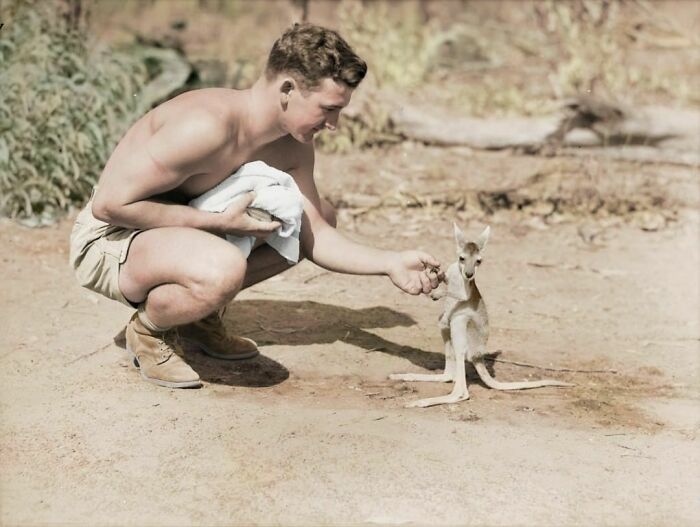
Happy Australia Day! An soldier at an advanced Allied base, with his pet kangaroo, location unknown, most likely NQ. Pets were something relatively new in WWII, but amazingly common. Although since the beginning of war animals had been used for different proposes it wasn’t until modern times when animals where used as company and not as means of military ends. Several battalions, divisions or armies had their own pets; however, platoons used to find lost animals because of the war itself and took them around. That’s why most of the pets we can find in WWII photos are usually attached to an only individual. Frequently, soldiers came across with those animals, which could be dogs, cats, bears, kangaroos, and even cassowaries -check my very first post-, and trained them, which eventually led to the creation of capable animals that would help in combat, more than simply pets.
10/09/1942, John Earl McNeil
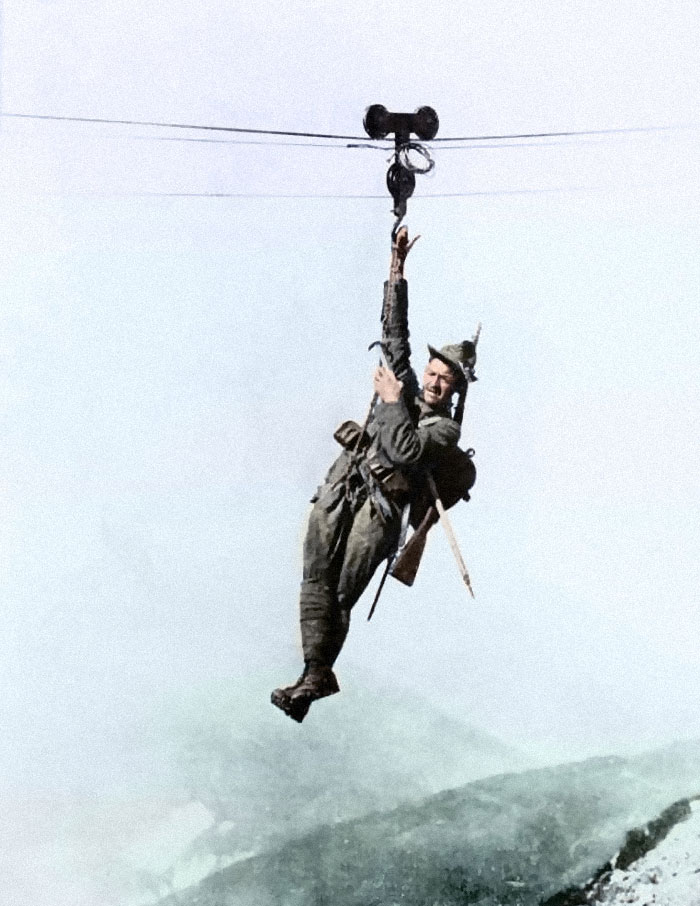
An Italian Alpino mountain specialist ziplines from one peak to another, c. 1917. Although ziplines might be seen as an indicative of amusement or military operations, they have been used as easy and cheap transportation method during centuries, specially on mountainous regions, such as China’s Yunnan, where even ziplines were used instead of bridges. In Australia, for instance, they were used for delivering food, cigarettes or tools without the need of crossing valleys and rivers, something adapted in war times.

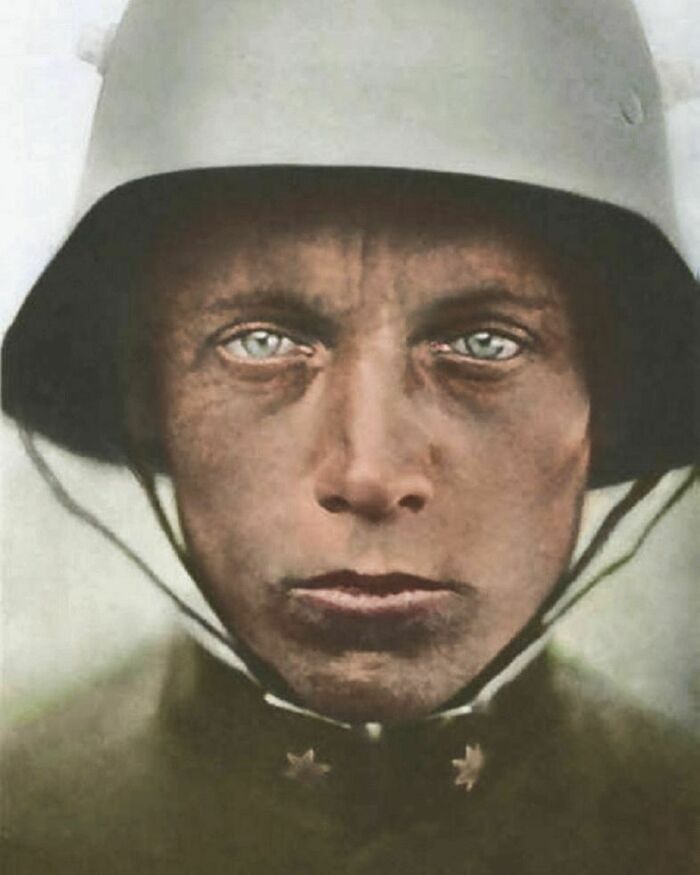
An Austrian lance corporal with a thousand-yard stare. I’ve talked with you before about the thousand-yard stares. Do you know where does the expression come from? The phrase was popularized after Life magazine published the painting “Marines Call It That 2,000 Yard Stare” by World War II artist and correspondent Tom Lea. The painting depicts a Marine during the Battle of Peleliu, from whom Lea said: “He left the States 31 months ago. He was wounded in his first campaign. He has had tropical diseases. He half-sleeps at night and gouges Japs out of holes all day. Two-thirds of his company has been killed or wounded. He will return to attack this morning. How much can a human being endure?” 1918

The eyes in this image capture very well the loss of soul these young men experienced in every war.


He never received treatment for his PTSD because it wasn't a thing yet. He was likely told to get off his a$$ and man up. It was called shell shock at that time and later called battle fatigue. These men literally sacrificed their lives and sanity defending freedom.
"Some people are against colorizing," the artist said. "They [say that by going through this process, the picture loses its meaning]. [But I feel that] leaving a picture in black and white should be mandatory only in academic research; it should not be restored either, because every detail ought to be left in its original state."
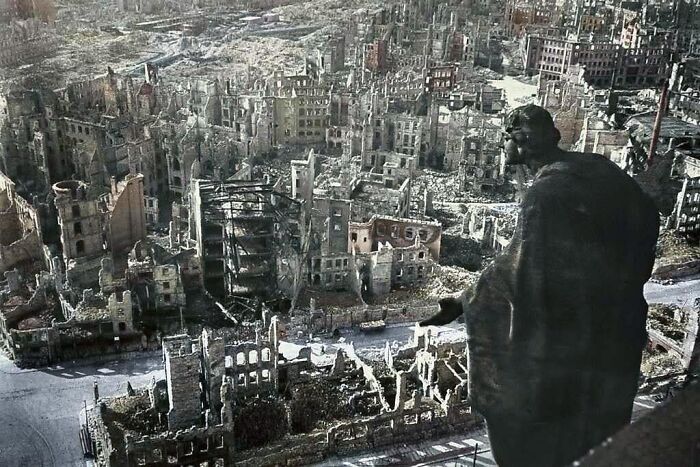
Today marks the 75th Anniversary of the Bombing of Dresden. Here pictured is the destruction of the city as seen from the Rathaus, or town hall, months after the bombing. The bombing of Dresden took place between 13 and 15 February 1945, when 1249 British/American heavy bombers directly attacked the city of Dresden, the capital of the German state of Saxony, dropping more than 3,900 tons of high-explosive bombs and incendiary devices on the own city, destroying 6.5 km² of the city's cultural centre. Up to 25,000 people were killed, most of them civilians, and leaving hundreds without roof. The official version pointed out to a “strategic target” referring to 110 in the area. Half of the attacks occurred directly to the city centre, dropping a total tonnage of 2659.3, the biggest in the whole bombing, and without any rational explanation. Only one raid targeted industrial areas, and three a railroad. Moreover, a considerable part of the actual military and industrial terrain was never bombed, instead a great part of the Dresden cultural landmark with little or none strategic significance was transferred into ashes.
The bombing of Dresden was just mad. It was said to be save and was full of refugees, which means mothers with their children and old people. They threw firebombs and it was horror. My grandma was nine years old at that time. She was there as a refugee with her mom 32 at that time) and her two younger brothers. They were in a train just outside the city and were lucky to survive because the city was so crowded with refugees they couldn't get in anymore. So they saw the city burn and feared for their own lives without a place to hide. After that night my grandma never slept without the lights on. A short time before she died in 2014 she often woke up at night, totally scared and thought the house was on fire and she had to get her children out. War might end but it never leaves you.

My grandmother had, pure coincidence, left Dresden shortly prior to the bombings. When she had gone quite potty with old age, I found her once, shaking uncontrollably, saying: Dresden is burning, Dresden is burning, look, the sky is fire. She remembered what it had looked like from afar. War is an abomination.
Load More Replies...
Estimates of civilians killed in this war crime are as high ar 250,000. it was a refugee center and the 25,000 only accounts for normal residents.

estimates for the siege of Leningrad put the deaths at around 800,000 civilians starved to death.
Load More Replies...
Rational explanation for strategic significane: Terror to reduce support of the regime within the citiziens and lowering the will to keep the war on. Very dark times back then, no major force in that war could count as the good guys
This was an awful war crime that should be forcefully condemned, but it is an unjustifiable rewriting of history to suggest there was not good and bad in World War II. One side was the aggressor pushing forward a war of conquest and racial supremacy while committing perhaps the greatest genocidal atrocity in world history.
Load More Replies...
Both sides committed bombing atrocities to be fair. The Allies bombed Dresden. The Luftwaffe bombed Coventry, which had no factories, no military connections whatsoever. Brighton got bombed too, a cinema full of children got hit. There was no glory on either side.

Yes. Kurt Vonnegut is a great author. Movie is good too
Load More Replies...
Or as someone on the college thread said "crystal snatch" (still shaking my head on that one)
Massive bombing strategy began there, and in spite of its complete lack of moral justification and actual utility in a war, it is still a thing now.

This was a war crime. Bomber Harris and Churchill were directly responsible for its commission. It was far from being an isolated incident either..
We as humans learn more ways to kill than embracing ways to cure and prolong life.
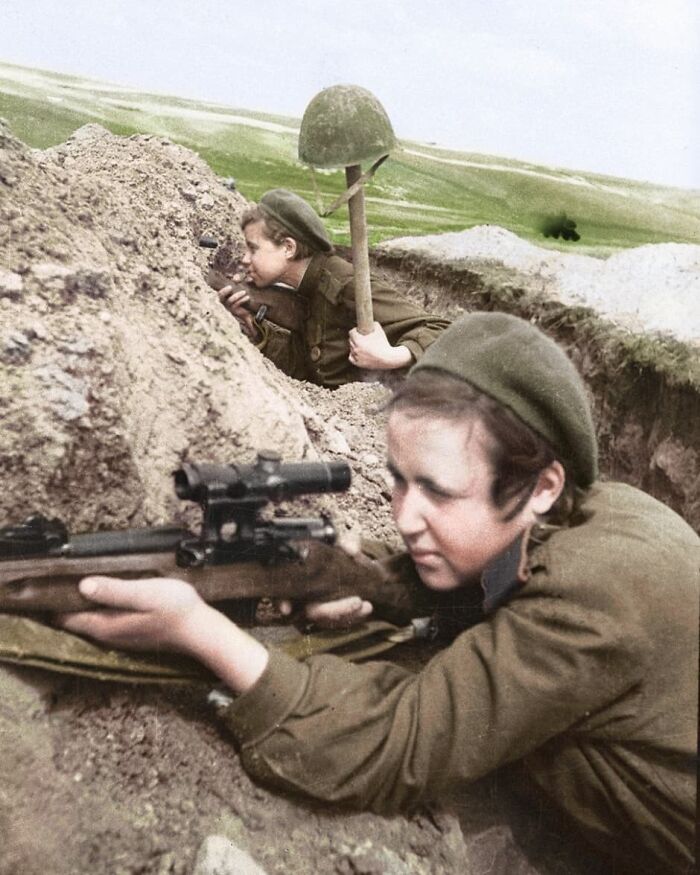
Two female Russian snipers shooting from a trench somewhere in the Eastern Front, 1943. Sniper’s baits were common in the Second World War, and were supposedly born during World War One, with even whole mannequins portraying infantry soldiers. Here depicted, a helmet bait, that would trigger the enemy soldier to shoot from the other trench and therefore to be within range of the allied sniper.
They are children. Ruthlessly trained to kill, children.
Load More Replies... Look how young they are. It's one thing to be a regular soldier at a young age, but to be that specialized at their age amazes me. That and the fact they, as girls of that era, were even there at all, makes my head spin.
"...that would trigger the enemy soldier to shoot from the other trench and therefore to be within range of the allied sniper." - I think you meant "locatable by" rather than "in range of". Shooting doesn't magically bring you closer to your target.
Russia had many female snipers. If this photo is staged (which I doubt) it takes nothing away from the highly skilled female snipers who fought for their country.
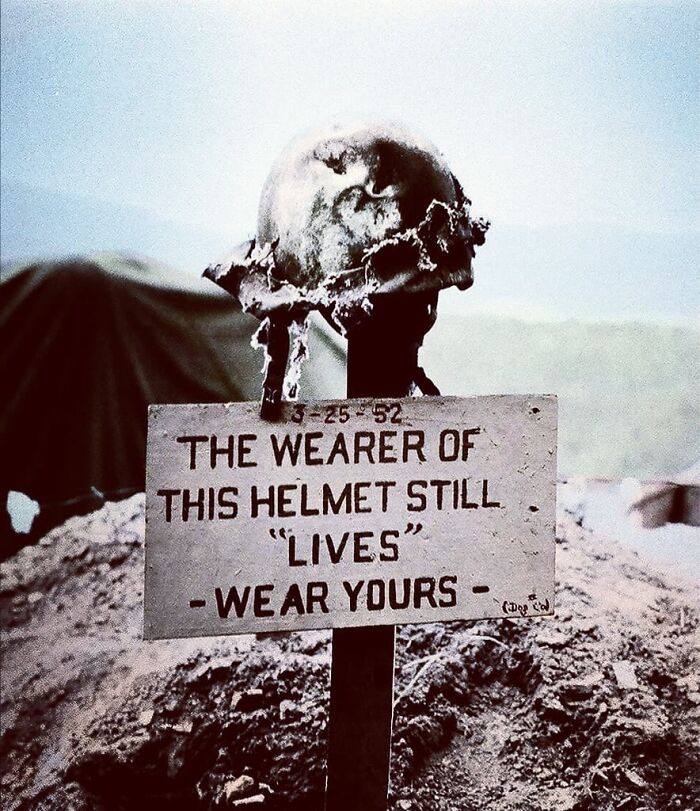
A sign erected by a man form Dog Company during the Korean War, 25th March 1952, Korea. Maybe taken after the Battle of Maehwa-San, or during the Fourth Battle of Seoul, this picture is just one of many similar that spread during WWI, WWII, the Korean War, and the Vietnam War. This is my fastest colorization, 12 minutes. It’s not a good colorization, but I wanted to test new techniques with this one, to make it look like an 80s photo.
Did you perhaps mean the "quotation marks"? I was wondering whether the soldier "lives" (as in, is barely functional) or actually lives a full life. The quotation marks seem out of place.
Load More Replies... 
We can bring this message forward to today - The wearer of this mask still lives. Wear yours.

i have a picture of my grandfather in Korea that i colorized with photoshop years ago, looks a lot like this. somehow adding color makers them more amazing

"We luckily work with a scanned version of the picture, so the original is not altered and we always count on [it to remain unaltered]. Now, I find that most romanticizing views on black and white are not related to this fact, but to an idealization of the past that is usually related to the idea of 'leaving the past as it is. These ideas are usually related to especially raw and debated themes of our recent past. When it comes to the Holocaust, for example, many people would prefer to leave these pictures untouched. I believe not colorizing these pictures means betraying our past."
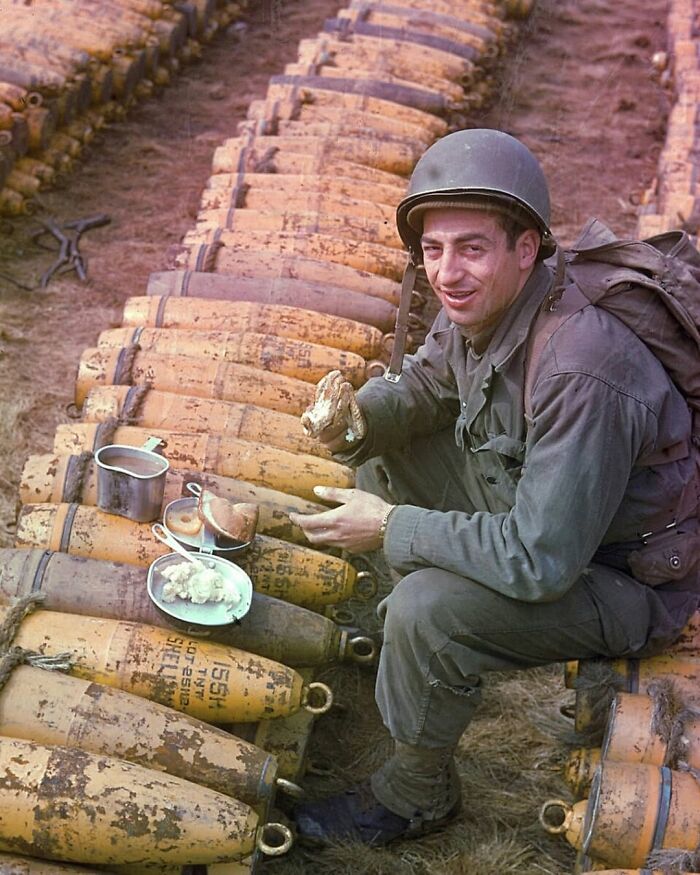
An original colour picture from World War II. While most pictures taken both by press and propaganda offices, and, of course, soldiers, were in black and white, several journalists or servants were giving new colour cameras. Innovations such as Kodachrome (1935) and Kodacolor (1942/1958) brought never-seen-before results to photography and nowadays are a faithful guide to colourisers.
No big deal, these shells are in their transport configuration with lifting plugs installed. Those rings would be removed and replaced with detonation fuses (or fuzes if you're British) when prepared for firing.
Load More Replies... (I laughed too loudly in class, my teacher asked to see what's going on and snorted)
Load More Replies...
I’ve been waiting more than a week to make this public. A month ago, we published a monographic book about colorization on Germany and France in WWI. The books illustrate the war in the Western Front with detailed attention in the captions of more than 80 pictures in full color colorized by me. It is named ‘German & French Armies in the Great War’ and has been published by Soldiershop.

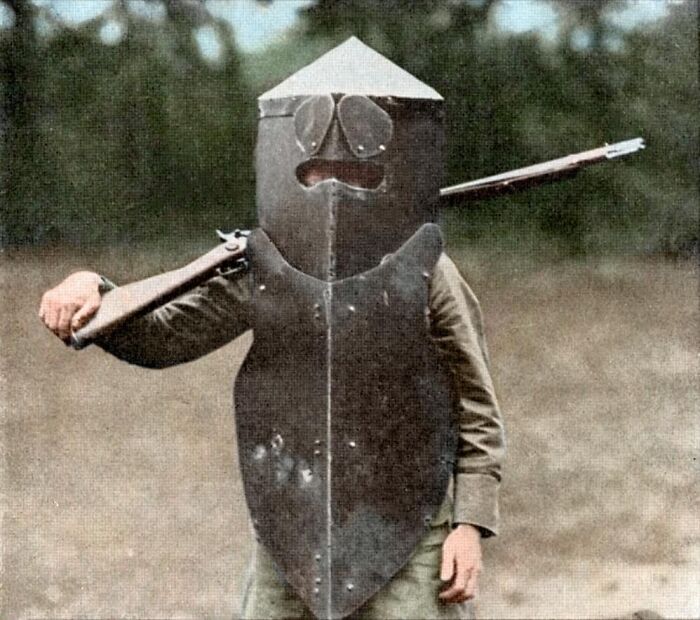
U.S. soldier wearing a Brewster Body Shield, 1917. The Brewster Body Shield, also and more accurately known as Brewster Body Armor, was the first American body armour to really be useful developed by and for the United States Army in World War I. Essentially, it consisted of a breastplate with an attached headpiece, both able to stop machine gun bullets at an average speed of 820 m/s. The main problems were its heaviness, which was nearly 28 kg. and its discomfort for soldiers. An adapted armour of 5 kg was later created, which fit close to the body, and was considered more comfortable.

I know I'm going to be down voted for this, but here goes: does anyone else see "The knights who say Ni!" ?

"All events in history have happened in color; photographers from the early 20th century would have shot in color if they had the opportunity (Robert Capa did when he was offered the chance). Colorizing is nothing more than a kind of restoration, it brings back to reality something that was lost or that is imperceptible. Restoration can never be completely precise, but like paintings, detail can be restored with an amazing level of accuracy."
Bellviure believes that all pictures should get this chance.
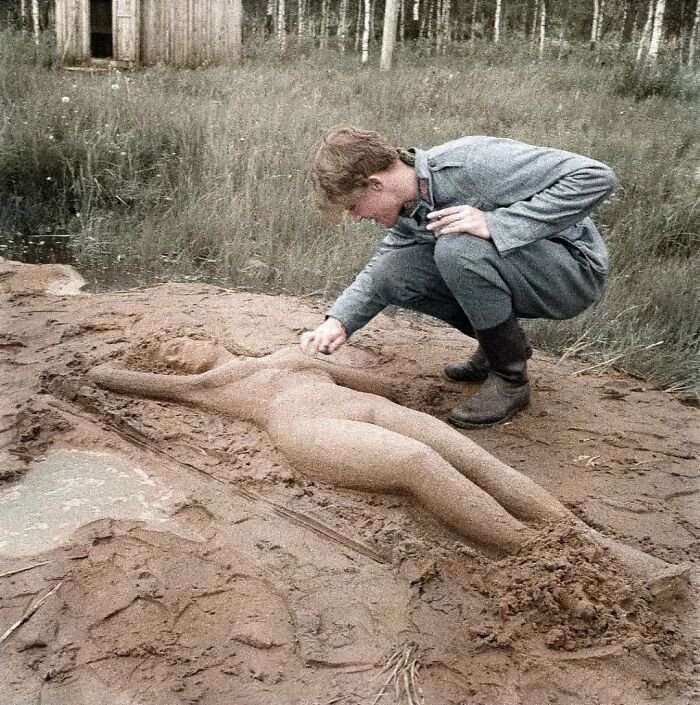
Finnish artillery corporal Niman sculping a feminine figure in sand, during the Continuation War, Valkjärvi, c. 1943. If you want to know more about Finland in WWII, I prepared a long ago a series of three posts about the Winter War, the Continuation War, and the Lapland War. Now, let’s talk about unique things about Finland. The country was the only one that sided with Germany, but in which native Jews and almost all refugees were safe from persecution. It was the only co-belligerent of Nazi Germany which maintained democracy throughout the war. It was also the only belligerent in mainland Europe to do so.
Finland was awesome during WWII, declaring war on both the Soviets and the Nazis!
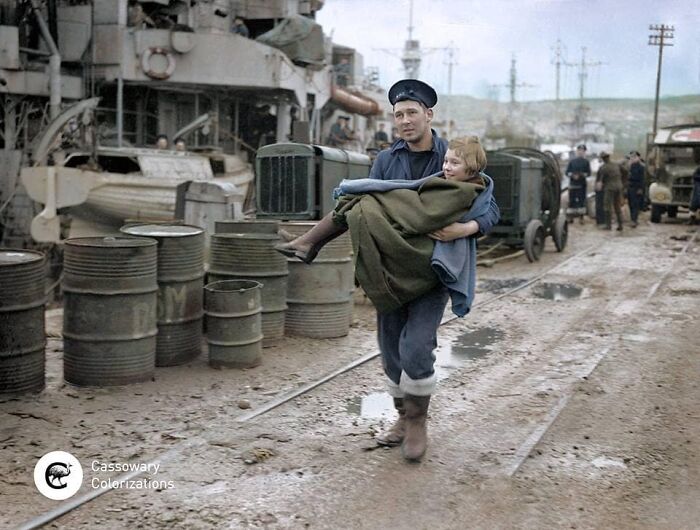
A Norwegian child being carried to an ambulance from HMS Onslaught at Gourock, Scotland, 1 March 1945. She was one of over 500 civilians recued by the Royal Navy after hiding from the Germans on Sørøya island. 525 Norwegians, who had been hiding from German patrols in caves on the snow covered mountains of Sørøya island, Norway for three months, were rescued by four British destroyers of the Home Fleet who raced in broad daylight, 60 miles behind enemy lines and took them safely to a Gourock.
Amazing all of the heroism during the wars...happy to see the pictures showing it as it was
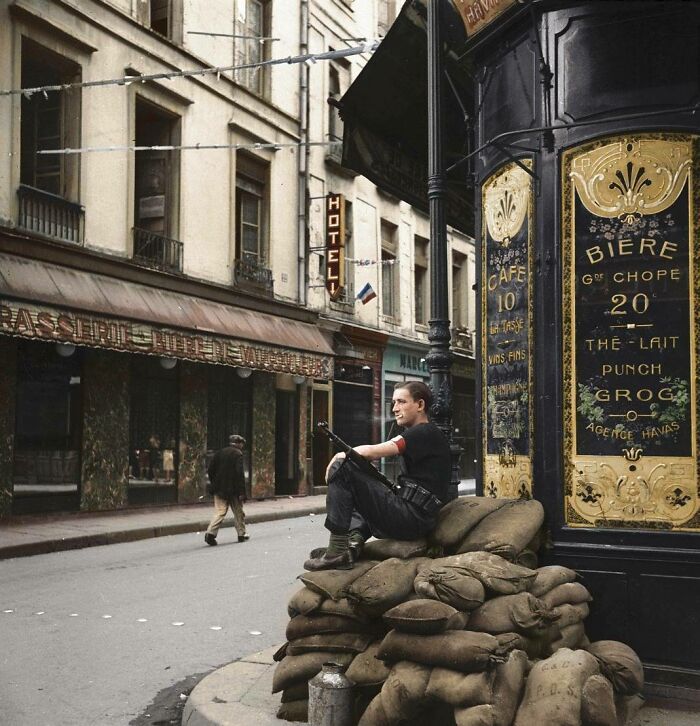
My favourite colourisation I’ve ever done, and I must thank ww2_forgotten_history for sending it to me. It depicts a French Resistance member during the Liberation of Paris, 23th August 1944. We have been searching the actual location trough Facebook, through our beloved WW2 Colourised Photos page, where it was featured. Lots of people helped us to try to solve that mystery, but we still couldn’t find it.

Is it the Cafe Bonne Biere 32 Rue du Faubourg du Temple, 75011 Paris, France?
It certainly looks like it could be, but I cannot match any of the architectural features seen above to any of the buildings across the street.
Load More Replies...
This is incredible. My grandfather was in the Wehrmacht and died in a street fight with the Resistance on this exact date. I wonder if this was the chap who pulled the trigger?

Since the bar across the street is called "Brasserie biere de Vauculeurs" I'd rather assume it is the Rue de Vauculeurs in the 11e Arrondissement. However I'm just assuming
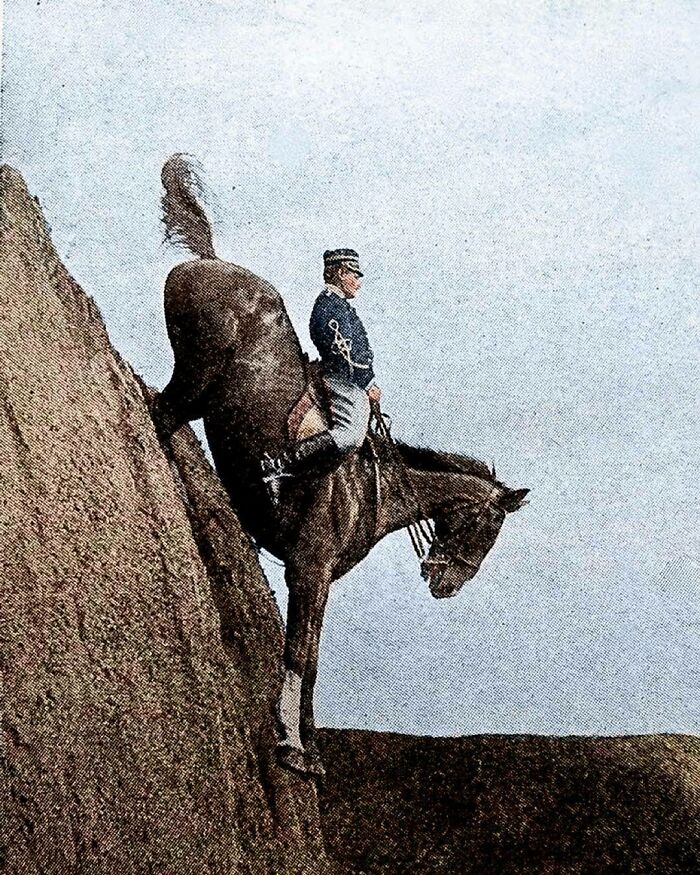
An Italian officer descending the Mombrone during his last exercise, 1906. The Italian Cavalry School, created in 1823, was responsible for the training of all armed forces cavalry staff. Every officer of the Cavalry School in Pinerolo (near the Alps) was required to go down “the descent of Mombrone” before they left the school. The 6 metres drop from the window of a ruined castle about three miles from Pinerolo was considered a test of nerve. Similar training exercises were taken at Fort Crook, Nebraska.
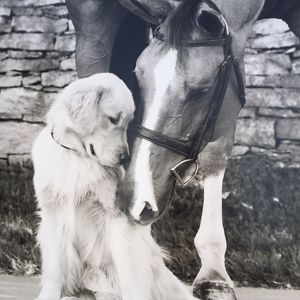
Actually, the rider is handling this very well. They are leaning back and not pulling the reins. They actually have steep hills such as this in high level jumper shows.
Load More Replies... 

except for in Skyrim you would be sitting up straight and the horse would be walking as they do across a road XD
Load More Replies...
Ikr? Whose nerves - the soldier's or the horse's?
Load More Replies... I loving this. I trained under a retired cavalry officer (WW2, he was in his 70's in the early 80's) and we'd go up into the mountains above El Paso (where Henry Chamberlain worked and wrote Training Hunters, Jumpers, and Hacks) and do this kind of scrambling down hills. Keep your horse straight, support his front end and they can do this rather easily. There are images of the Italian Army from that era on Youtube, a joy to watch.
No, actually, not at all. Many were very fitted up for the work and so few injuries. These weren't weekend warriors, these were horses that worked daily. It's not falling, it's sliding down the hill. I've done it.
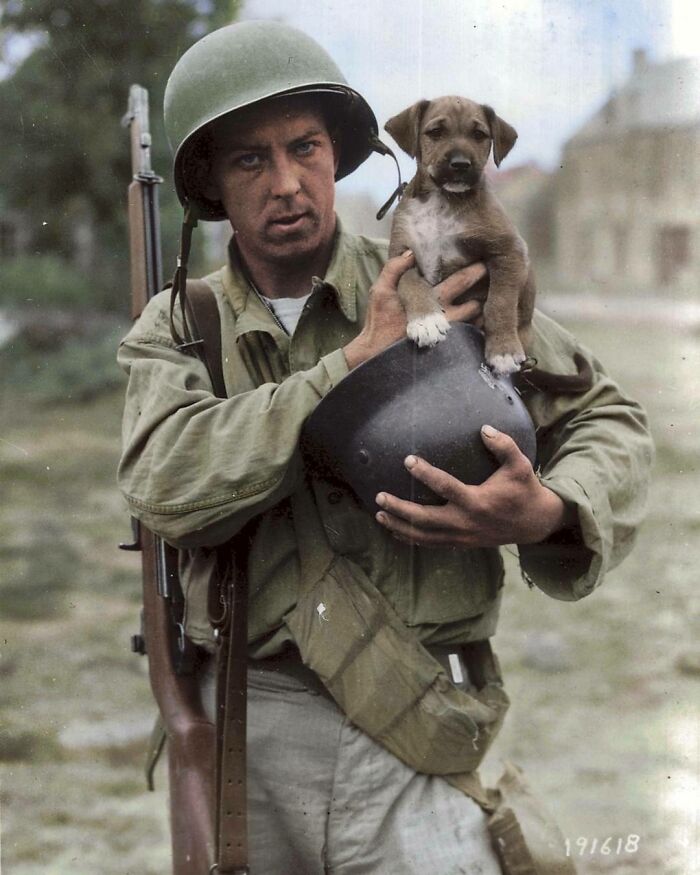
Load More Replies... Pfc Joseph E. Day (1918-2009), in underpants, holds a puppy named "Invasion" in a German helmet, Le Dezert, France, 1944. Concerning underwear, it was largely an invention of the 1930s. On 1935, an engineer named Arthur Kneibler, designed the world's first briefs in Chicago. During World War II, elastic waistbands and metal snaps gave way once again to button fasteners due to rubber and metal shortages. Undergarments were harder to find as well, since soldiers abroad had priority to obtain them. By the end of the war, Jockey and Hanes remained the industry leaders in the US, but Cluett, Peabody and Company made a name for itself when it introduced a preshrinking process called "Sanforization", invented by Sanford Cluett in 1933, which came to be licensed by most major manufacturers.
1944

a little therapy dog in the making. Hope they both made it out okay

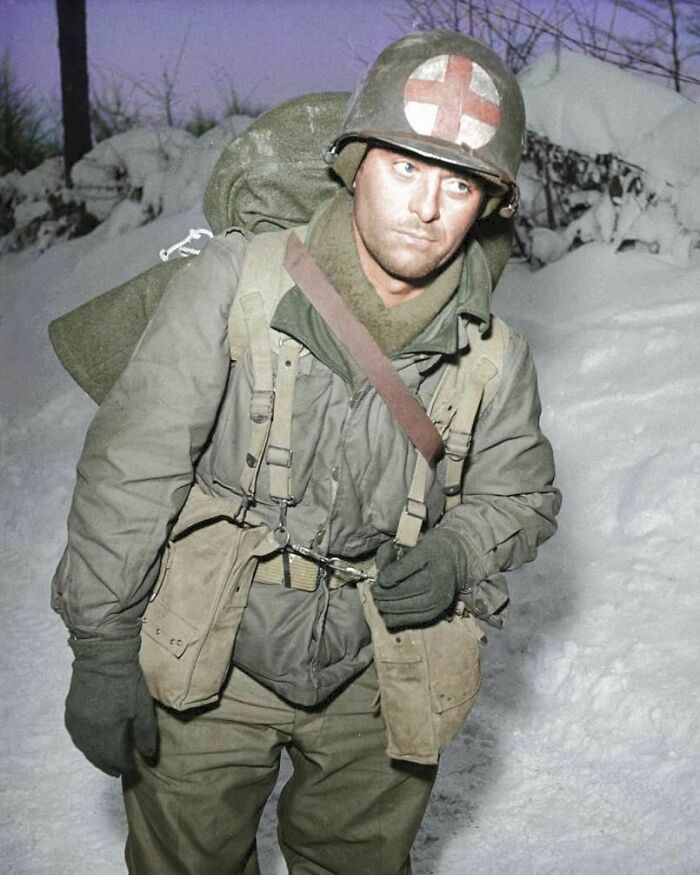
An exhausted American medic returning from the front during the Battle of the Bulge. Combat or Field medics in WW2 were military personnel prepared in a medical basic training, responsible for providing first aid and frontline trauma care on the battlefield. However, they could assist to other units even preparing patients for operations, making beds, or serving as cooks. Geneva Convention completely prohibits medics from using weapons. Medics could use a weapon to protect a casualty, but not themselves. Quoting Stephen Ambrose, "It was the universal opinion of the frontline infantry that the medics were the bravest of all".
If they are armed or not also depends on the circumstances. On the east front german medics didn't had markings and were armed as they were prefered targets of rusian soldiers. In the middle east medic vehicles and personl also rarely have red crosses for the same reason
Look for a movie called "Hacksaw Ridge" if you want to be inspired by a conscientious objector who becomes a medic. It's an excellent movie that you'll remember for a long time.

My Dad, Lawrence H. Taylor, was a medic at Iwo Jima. He died at 93 yo on April 29, 2019.
Ever heard of cleaning yourself? He is a medic, and I don't think that medics do a lot of combat things. Also, the battle of the bulge was not trench warfare
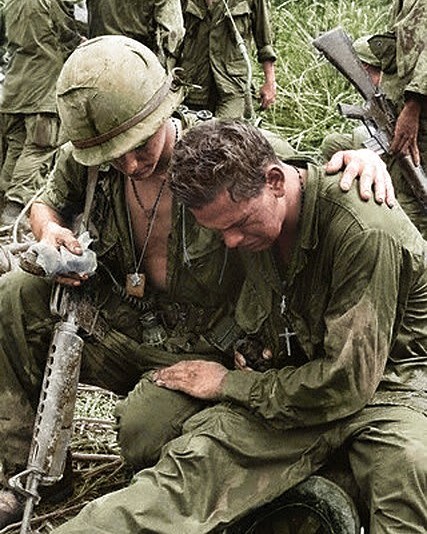
Load More Replies...Two soldiers comfort each other under the strain of combat in Pleiku, South Vietnam, 26 May 1967. Pleiku was strategically important during the Vietnam War because it was the primary terminus of the military supply logistics corridor extending westwards along Highway 19 from the coastal population centre and port facilities of Qui Nhơn. Additionally, its central location on the plateau, between Kon Tum in the north, Buôn Ma Thuột to the south, and the North Vietnamese Army's base areas inside Cambodia to the west made Pleiku the main center of defense of the entire highland region of the Republic of Vietnam. This was obvious to both sides; the United States established an armed presence very early in the conflict at Camp Holloway, and the Việt Cộng attack on this base in early 1965 was one of the key escalating events that brought U.S. troops into the conflict. On 15 June 1972, Cathay Pacific Flight 700Z, operating a Convair 880 from Bangkok to Hong Kong, disintegrated and crashed while the aircraft was flying at 8,800 m. over Pleiku, Vietnam after a bomb exploded in a suitcase placed under a seat in the cabin, killing all 81 people on board.
At the time, they didn't know that it wasn't going to be possible. They saw what happened in Korea and assumed it was going to be the same thing. The thing is that we (the Vietnamese) have a dying dedication not to the State, but to the people and won't back down when a foreign nation step into our lands and fire shots at our people. It happened when China, Mongolia, and France tried to conquer us and in the end, we still got our independence or protected the people from them.
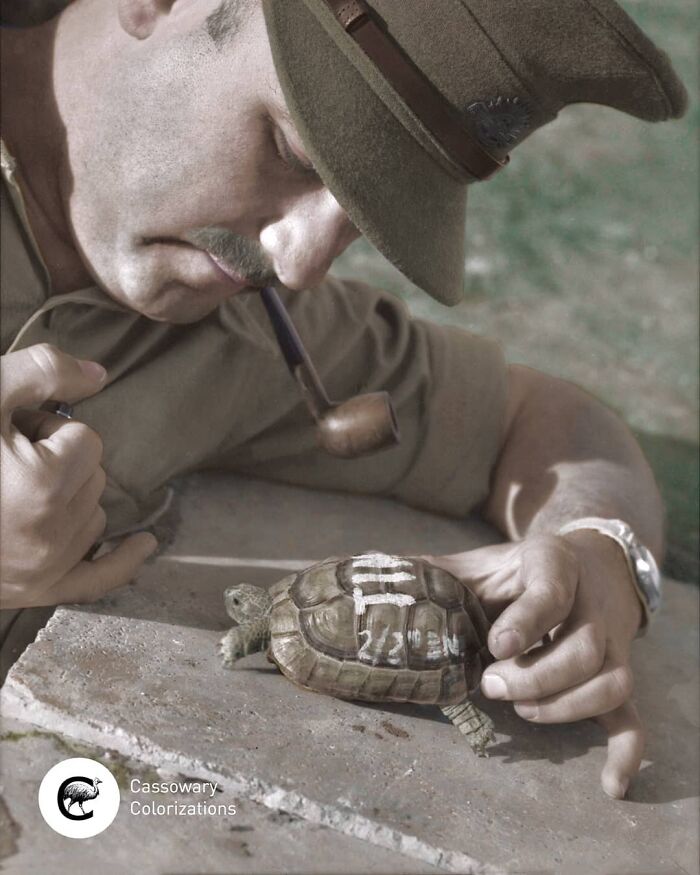
Load More Replies... Captain D. Michelson with Tim the tortoise, the pet of the Australian 2/2nd Battalion, 16th Brigade, 6th Division, Julis, Palestine, 28 March 1930. So I was curious about Captain Michelson, but couldn’t find anything about his service in WWII. The Australian War Memorial didn’t through any clues, until I searched just the surname and, hidden in a group picture, I found his complete name: David Enoch Michelson, SN - NX320, was born in Sydney (the 2/2nd recruitment area was NSW) on April 19, 1910. Enlisting in Denistone on December 27, 1939 was discharged six years later, on October 9, 1945. You can find several recordings and interviews of him in the Australian War Memorial website.
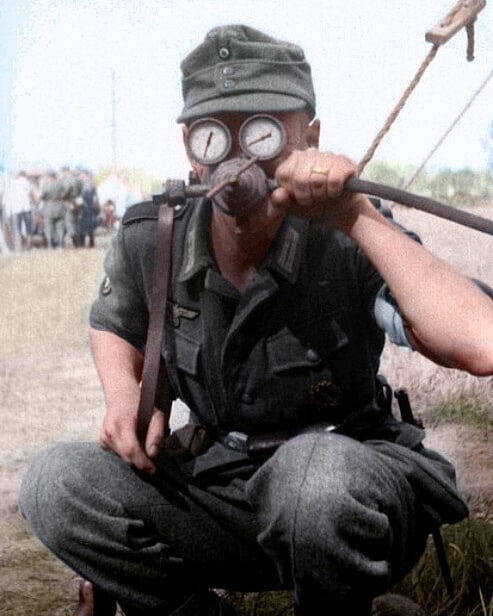
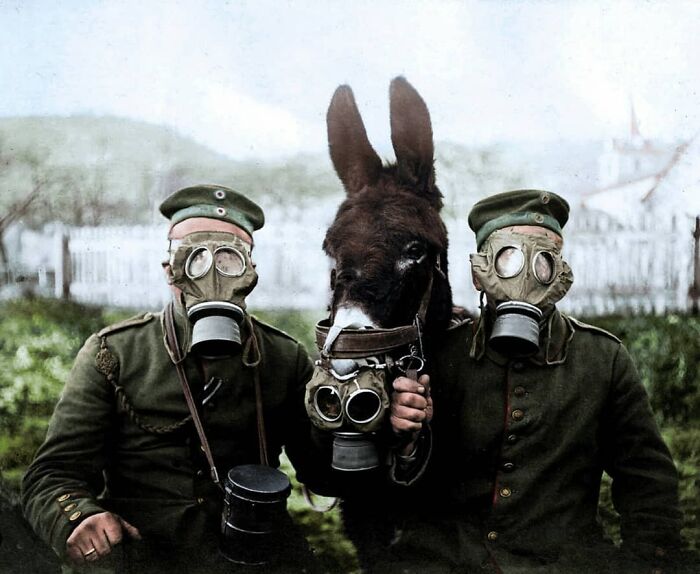
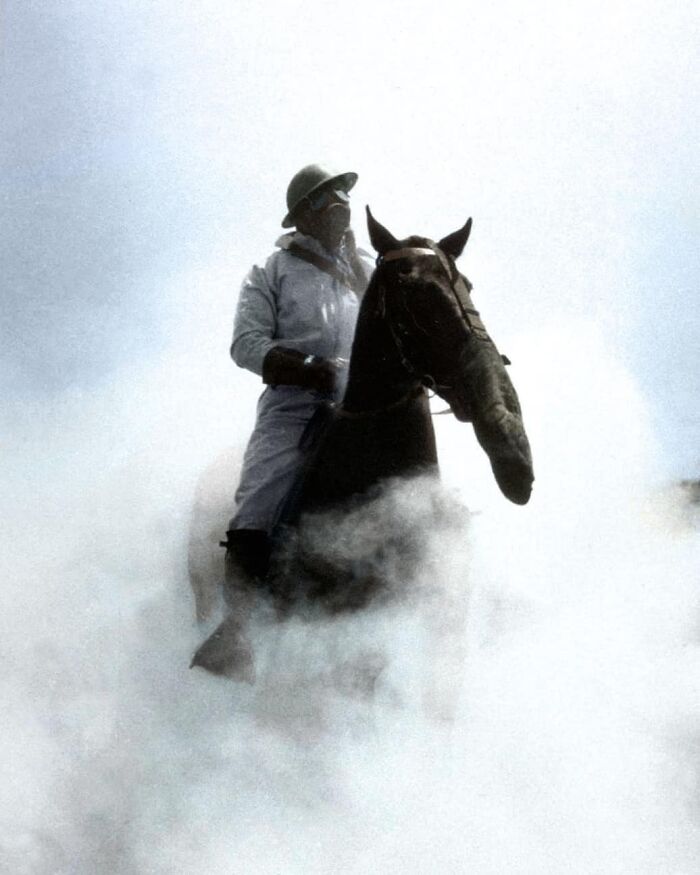
Sergeant Joseph Levin of the American Army Chemical Warfare Service testing a gas mask with his horse “Buddy”, Governor's Island, New York, 1928. This picture has long been credited as a Frenchman during the Battle of Verdun (something incredibly thoughtless because of many indications). More ironically, and what hurts me the most, is that Getty Images credits it as being an early 1930s picture and then, in another shot of the same man and day, as a 1917 picture. After I took some research, I discovered a similar photograph taken the same day in the Popular Science issue of October 1928. It is sad that a corporation as Getty, which charges colossal fees to its photographs doesn’t even bother to make a five-minutes research. I’ve transcribed you the original article: “ARMY DEMONSTRATES A NEW GAS MASK FOR WAR HORSES / Buddy, an Army horse stationed at Governor's Island, New York, is shown wearing the latest mask designed to protect war horses and mules during gas attacks. The bag of the mask fits tightly over the nostrils of the animal and is held in place by straps buckled over its head. Buddy demonstrated the effectiveness of the new protection recently when he carried Sergeant Joseph Levin of the Chemical Warfare Service, through a deadly screen of poison gas without suffering ill effects. Levin is seen wearing the newest equipment developed by Army experts to protect soldiers.” The American Chemical Corps was and still is one of the many branches in which the United States Army is divided. It was created the 28 June 1918, few months before the First World War ended, named the U.S. Chemical Warfare Service (CWS). After the Second World War, its name was changed to the current Chemical Corps. For most of its history, the Chemical Corps was tasked with delivering chemical weapons rather than defending against them.
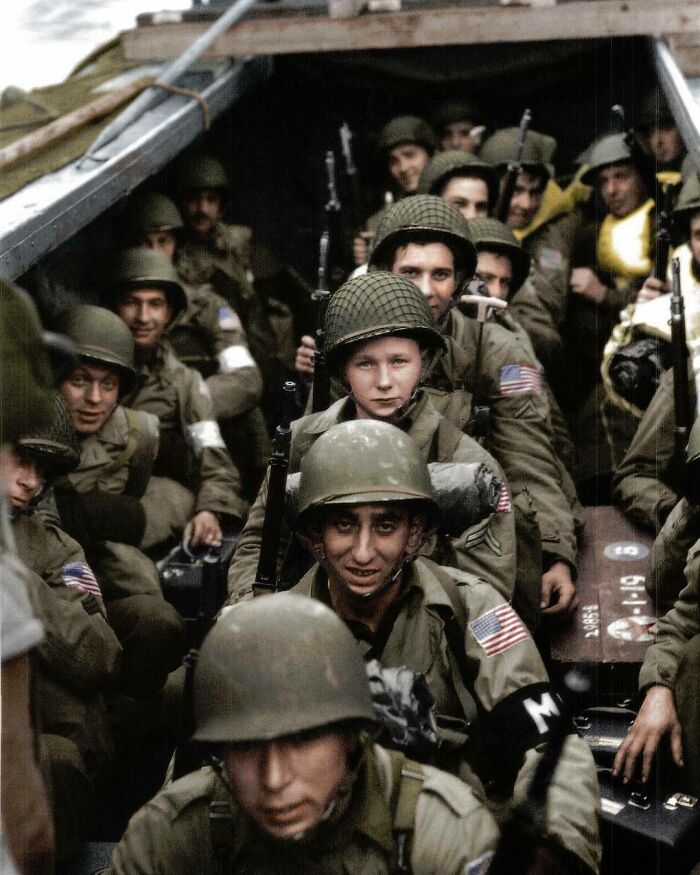
American troops on board a landing craft heading for the beaches at Oran in Algeria during Operation Torch, November 1942. Today I was reading a Victor Hugo’s poem which made me think why couldn’t I do something rather original: composing a poem while colorizing a picture, evoking the picture in words. I’m deeply sorry if this seems irreverent, but here it goes.
The bitter weaving holds the sound
of the darkest scream beneath the bank.
The sewed badge in the shoulder dies
with the moans of white, red and black.
As the ship approaches the dying shore,
Its breath embosoms the crimson sand.
And, as the filth of an unborn child,
the men jump into a shore of wrath.
The helmets hold the hope of most,
the grenades, the hands of twenty more,
the uniforms turn into a deeper moan
and the brave, gloomy men pray and cry
without even reaching the rage’s coast.
They shout the word of a dratted god,
they confess their duties to the ghost
of a flowing glory; today may be gone.
And the water embraces them all,
with the sorrow of a widow’s cough,
and it spits them all into the wall
of blood, darter, and expired goals.
Now, the fourteenth weave tries to bend
the moral of the mysterious men
who perished in the glazed arms
of a far, pitiful, unknown land.

This is a familiar pic in my family because I have a nephew who is a dead ringer for the soldier in front. We have teased him about it for years.


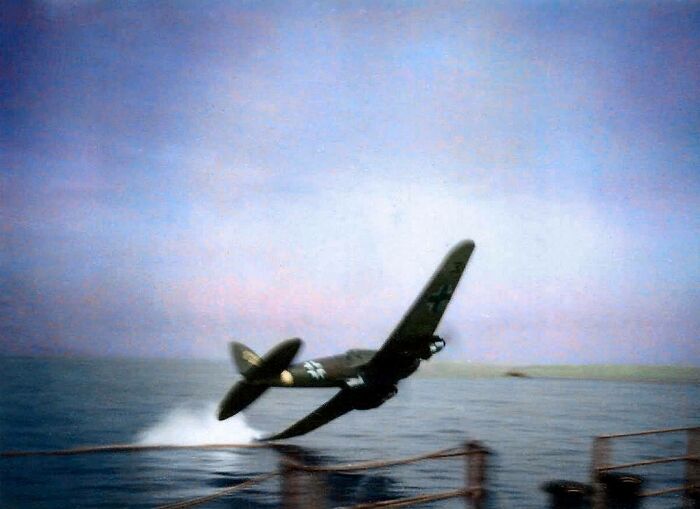
A Heinkel He 111 crashing directly into the sea, date and place unknown. This He 111 is only one of thousands that wrecked during World War Two, and that currently lie beneath the silence of the seas. Only on the little island of Malta, it’s reckoned to be 800 wrecked planes, a third part of the 2700 planes that participated along the Allies and the Axis in the bombing of Malta.
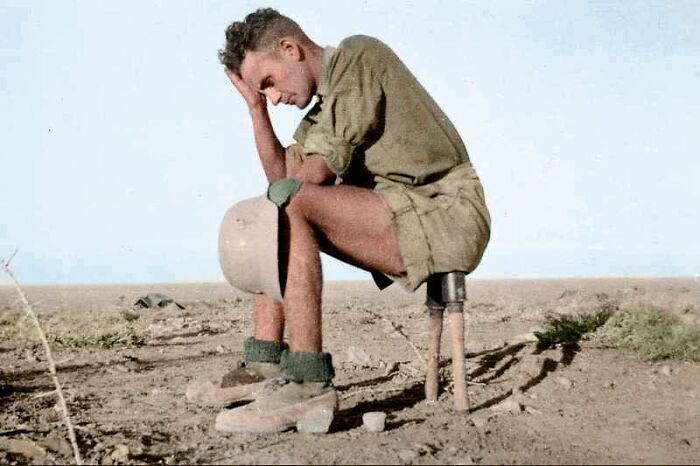
Afrika Korps, shortened DAK, soldier sitting on two M24 Stielhandgranates in the North African theatre, 1942. Although this picture seems pretty dangerous, the chance that the grenades denotated was very difficult and even those could be neutralised grenades. I’ve just realised that I have hardly even made DAK posts, so I am going to explain a little bit what and how it worked. The Deutsches Afrikakorps was -and this is something people ignore in many occasions- an expeditionary force, not any kind of formation as a division or a battalion, mainly made out of motorised divisions, created in 1941 and handed directly by Adolf Hitler to Erwin Rommel, both having very close relations. The first intention of the force -another ignored fact- was not to conquer or to expand Germany’s colonial control, but to support the Italian fascist forces trying to reconquer Libya, which had had serious trouble. After outstanding military victories, and after the brave yet disastrous fights of El Alamein, the DAK was dissolved on 13 May 1943.

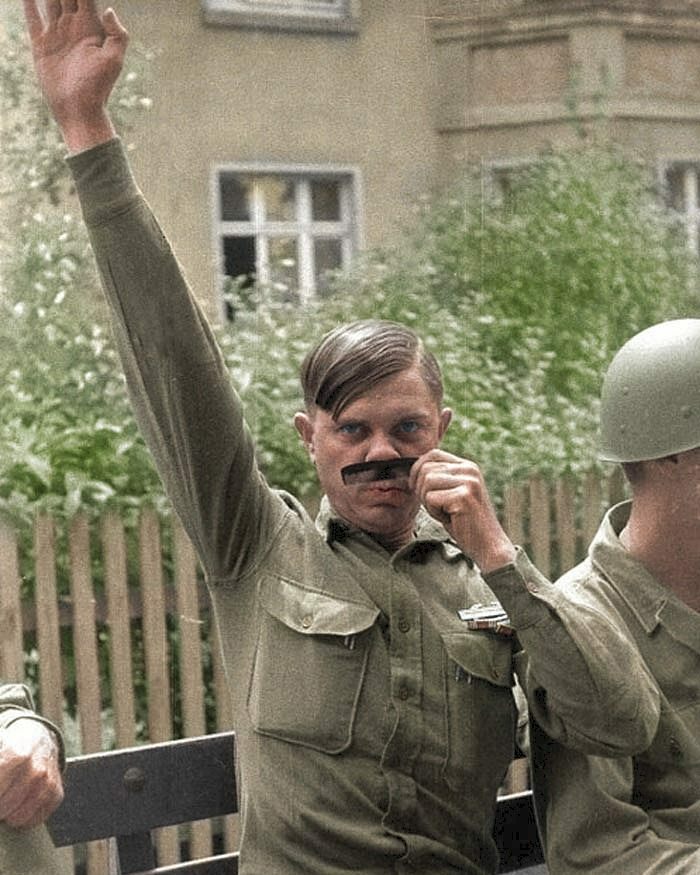
An unknown American soldier in Summer Service Uniform mocking Hitler’s moustache with a hair comb. Depicted in his uniform, a Combat Infantryman Badge, a Good Conduct Medal and an unknown medal. The Good Conduct Medal is one of the oldest military awards in the United States Armed Forces. Although the U.S. Navy's variant of the Good Conduct Medal was established in 1869, the Army version wasn’t scheduled until 1941, and the Air Force on, until 1963. The medal is awarded to any active-duty enlisted member of the United States military who completes three consecutive years of "honorable and faithful service, which means not having any non-judicial punishment, disciplinary infractions, or court martial offenses. During wartime, the Good Conduct Medal may be awarded for one year of faithful service, or even awarded posthumously.
c. 1944
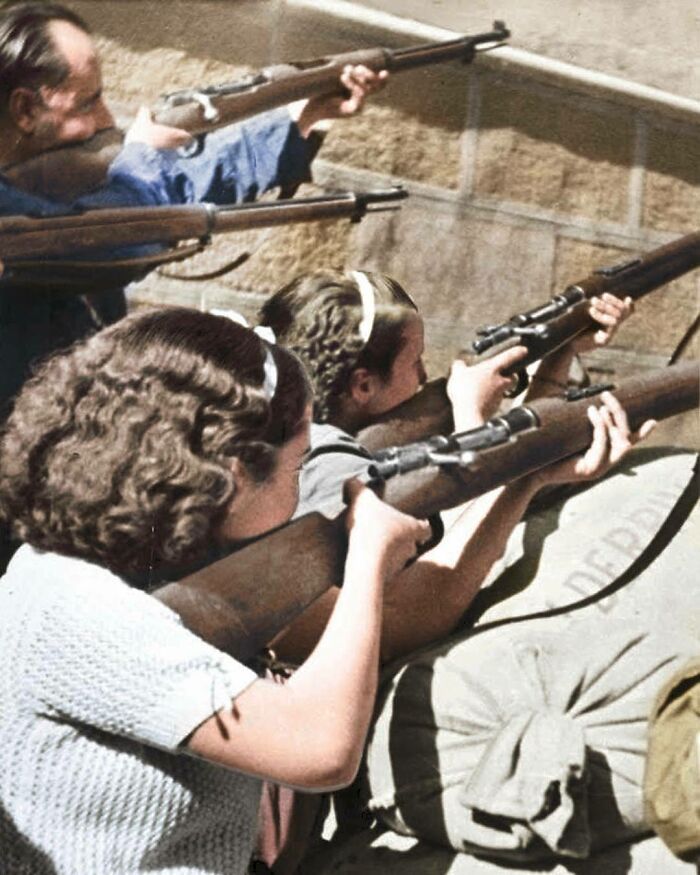
Two women and what seems to be an Assault Guard during the Siege of the Alcázar, in Toledo, during Spanish Civil War. The role of women during the Spanish Civil War was very different between sides. During the years of the 2nd Republic (1931-1939), women started to gain freedom, strictly censored by the dictatorship of Primo de Rivera (1923-1930), and in 1931 women’s right to vote was approved. During the war, in the Republican side, women reached the biggest ladder of liberties, and eventually saw themselves standing in the battlefield among men. On the other hand, in the Nationalist side, women were strictly prohibited from bearing arms, and their task was relieved to nursing. Later, during Franco’s dictatorship (1939-1975), the so called government made up a plan where woman where supposed to fulfil the role of wife, mother and housewife, with single-sex school policy. The women had to wear long and little scandalous clothes, with a censorship present in the media and especially the cinema, stepping 40 years back. Pilar Primo de Rivera, member of the Falange, said once: “Let's be nice and funny little ants”. 1936

Or read "The Forging of a Rebel" by Arturo Barea. A literary masterpiece.
Load More Replies...Considering colorization as an art form that bridges past and present, readers might find the stories of animal bravery during peacetime even more compelling.
Each photo tells a story, much like the acclaimed wartime photos capturing animals that served bravely in WW1 and WW2. Exploring these narratives deepens our understanding of the contributions that even the smallest creatures made.

So grateful my father survived the Vietnam conflict, my Grandfather survived WW II and my Great Grandfather survived WW I. And now there are ungrateful people who complain about wearing a mask!!

It's strange how color can make these pictures seem more real. Black and white pictures seem more historical, like textbook reading.
I am not in any way affiliated with the artist, but I love the work so much: check out the YouTubev channel of Mystery Scoop, where they colorize and AI animate old photos and paintings. It's startling.
Load More Replies... So grateful my father survived the Vietnam conflict, my Grandfather survived WW II and my Great Grandfather survived WW I. And now there are ungrateful people who complain about wearing a mask!!
It's strange how color can make these pictures seem more real. Black and white pictures seem more historical, like textbook reading.
I am not in any way affiliated with the artist, but I love the work so much: check out the YouTubev channel of Mystery Scoop, where they colorize and AI animate old photos and paintings. It's startling.
Load More Replies... 























 No fees, cancel anytime
 then open in external browser


 and click "Open in External Browser"