Get Premium
Dark mode theme is available exclusively for premium users. Learn more about the benefits of subscribing.
No fees, cancel anytime.

 Dark Mode Ad-Free Browsing Unlimited Content
 Ad-Free Browsing Unlimited Content Dark Mode
Join 1.2 million Panda readers who get the best art, memes, and fun stories every week!




Everyone is talking about boundaries these days. It seems like you need them everywhere - with your family, friends, work, and even strangers you meet on the street. Having them is, indeed, smart and reasonable, but how do you even set them?
That’s where professionals come in. In this case, a professional on TikTok. Kami Orange, a boundary coach and influencer, is sharing her favorite phrases that help you set limits and ensure no one is overstepping the line. She’s even made her top 40 list! Scroll down to see some of our favorite examples.
This post may include affiliate links.
 "I already said no, and I'm not going to change my mind. Please stop asking me." I've used this phrase with salespeople, people who are hitting on me, children, and anyone who's not receiving my NO. Your NO is important and deserves to be listened to.


I bought a suit, and then the salesman tried to sell me dress shirts and ties to go with it. When I told him I already had those, he said "Come on. Work with me here." I replied "Work with you? I'm buying the damn suit!"

A guy came to my door to sell some pest control service we did not need. I only answered the door because I literally made eye contact with him through the window as he walked up to my door. Anyway, he would NOT take a "no thank you" from me. Finally, I said, "I'm going to close the door now. Good bye" and ended it. But sheesh




When they do this - it seems normal to be referred to someone whose job it is to make you change your mind whenever you cancel a subscription - I just keep repeating the same short phrase. "I want to cancel" or whatever is appropriate without any other elaboration. After the fifth time of saying it, they get the message.


It's probably similar to assertiveness training from years back. Obviously, you don't need that kind of coaching, but some people genuinely have a hard time saying no. I find it helpful to have some phrases that I can use in different situations.
Load More Replies...There are a few different types of boundaries out there. The ones that usually come to mind when boundaries are brought up, though, are emotional boundaries. They relate to sharing how you feel about certain things. This can be related to various aspects in your life such as your body, your familial status, or your work. Sometimes these topics include sensitive information, so knowing how to put up a boundary there is important.
The sharing also goes both ways. Knowing what you’re comfortable saying is one thing, but knowing what you’re comfortable hearing is also important. Sometimes you do not want to be involved in someone else’s family or relationship drama. So, that’s why one needs boundaries to stop this type of oversharing.
 "Oh! That's not going to work for me. What other options are there?" To me, this is a really kind phrase. When I'm in a customer service situation, people are giving me options, and honestly, neither of those options are going to work for me. I'm not upset. I'm not mad. I just say, "Oh! What other options are there?" and it has been really effective.
 "I've asked you to stop multiple times, and you still keep doing that. What is going on?" This phrase works if you are genuinely confused or really curious, like, "I've asked you to stop, and you haven't stopped? Tell me what's going on?" It doesn't work very well if you are being snarky and sarcastic. But if you are sincerely confused, like, "Hey, tell me more about what's happening? Somewhere there's a communication gap?" Like, "I asked you to stop? You still keep doing the thing? Talk me through your thought process." This is a good phrase.
This is a phrase that will instantly put anyone on the defensive. It sounds like something a parent would say to a child, and adults do not like being spoken to that way. It ONLY works in a snarky way, and that's the only way it will be taken.

Agreed. And sometimes that might be the intent. But it's most likely going to escalate the issue.
Load More Replies...
Totally disagree - this works if done kindly compassionately and with a good relationships and reassurance -I use it a lot
Intellectual boundaries are quite similar to emotional ones, but it is about your beliefs, not personal experiences. They are usually related to more polarizing topics such as religion or politics. Being able to disengage and walk away from such conversations can spare you a lot of energy that is usually involved in such discussions.
Then, there are physical boundaries that are related to touch. This has to do with your personal space as well as friendly touching such as handshakes and hugs. Sometimes, some people can simply stand too close to us and knowing how to voice that feeling politely can save us a lot of discomfort.
 "I hope you're not saying that to me because you think that I agree with you!" You can say this one in that sassy way. Or you can just say it in a sincere, worried way.
"You might very well think that; I couldn't possibly comment" - Francis Urquhart. "House of Cards"
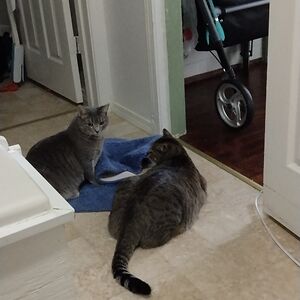
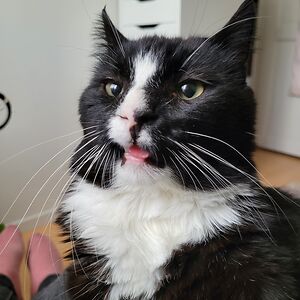
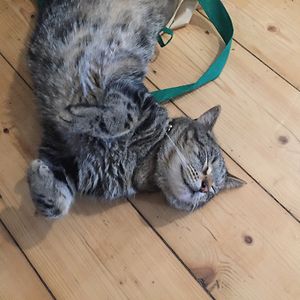
Audi is excellent at that blink, particularly when I'm rescuing him from whatever it is that he knows he's not supposed to get into. The joy of cats!
Load More Replies...
I've wanted to say something like this multiple times. But I feel it gets more complicated when I recognize I'm at risk of offending someone I also have to spend a lot of time with for whatever reason. I dunno maybe I'm just not brave enough. I try and find other things to say instead without agreeing.

This works well when someone starts saying something judgemental. It won't change their judgemental nature, not it may just make them shut up about it while you are there
 Here are five boundary phrases for when people ask overly personal questions.
1. Oh! Why do you ask?
2. Oh! People sure keep asking that, don't they?
3. I'm not sure what answer you're looking for with that question.
4. Oh wow! That's a really personal question to ask someone!
5. That's a sensitive topic for me. Let's talk about something else!
Here are five boundary phrases for when people ask overly personal questions.
1. Oh! Why do you ask?
2. Oh! People sure keep asking that, don't they?
3. I'm not sure what answer you're looking for with that question.
4. Oh wow! That's a really personal question to ask someone!
5. That's a sensitive topic for me. Let's talk about something else!


7. How does knowing the answer to that question impact my ability to help you? (Context: patron asked me what my religion was)
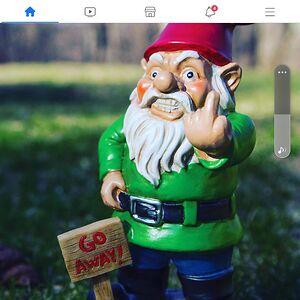
One nosy person who I had just met asked about my pay, rent, personal life etc. So I I countered it with, an equally personal question for them to answer. She went silent and said I don't want to answer such personal questions ask by someone I don't know! I replied neither do I in yet you continue to ask me. The woman spluttered and changed the subject.

"I'll forgive you for asking that, if you forgive me for not answering."
I find that saying "look, i know that this isn't really any of my business, so feel free to tell me to bugger off - can I ask you about [thing]?" works really well. I lot of the time I get an answer, and if they're not comfortable they just say so - I've already told them that pushing back is not an issue, so they don't get defensive.
"Where are you from?" "Hard to say." "Hard to say? Why?" "It's an awfully long word." - Easy Rider
 "I want to listen to you share this, but unfortunately, I'm not in a good headspace for this topic right now." People in my life who I love really, really matter to me. I do my best to really show up for them. Sometimes I don't have the bandwidth, I don't have the energy, and I have my own stuff going on, so it's not a good time for that. A phrase like "Hey, I want to listen to you share this, but I'm not in a good headspace for this topic right now." can be really helpful. If possible, I will tell them when I will be available to talk about that.

People like Harry tend to get their noses out of joint about any evolution of language. As someone who works with language for a living (translator), let’s just say that I don’t have the headspace for Harry sharing about that right now, or ever.
Load More Replies... Similarly, I've found that if I want to rant or have a conversation about a heavy topic with someone that I know has a lot on their plate, starting a conversation with "Hey, I want to talk to you about something important to me. Do you have the mental bandwidth to talk?" Gives them the ability to bow out if they don't
If the touching is more intimate, then you’re talking about sexual boundaries. This often has to do with kissing and sexual intimacy. Often, consent plays a big part in knowing and setting your boundaries. However, it’s not only physical. When you set your sexual boundaries, you can tell your partners how much you wish to undress or not, how you wish to be spoken to, and other details.
 "You interrupted me. I wasn't done speaking." "Oh! Hold up! You interrupted me. I wasn't done speaking." "Mmm-hmm. Yes. So what I was saying was that in the past..." Any script I offer about "interrupting" is super sensitive. Are there people who interrupt because of how their brains work? Yes. Are there people who interrupt because there's a power dynamic and they don't feel like they need to listen to the person who is speaking? Yes. Are there people who interrupt because their culture has cooperative overlap? Yes. There are many reasons that someone might interrupt, and there are times we need to say, "Oh! Hold on! I wasn't done speaking."

When interrupted, I don't stop talking. I just continue speaking as if this train has no brakes. The interrupter always gets a very awkward, uncomfortable look on their face. Interrupters hate being no-sold.
Especially needed when the other person is using interruption as a tactic to prevent you from making your point. At the first such interruption I look them in the eye and say "I'm not finished with what I have to say." If done properly, there will be no second interruption.
Load More Replies...
My go to response unless there is an obvious is "oh I'm so sorry the middle of my sentence interrupted the start of yours, how ruse of me"

Being interrupted is a major pet peeve of mine. I'll let someone know nicely the first time that hey, let me finish before you start talking. I will not be nice if I have to say it again.

Cooperative overlap! I didn't know the phrase, but that's what I do.
I'm so glad there's a word for it, I was beginning to think it was just me
Load More Replies... "I'd be more than happy to hear your objections/ideas/contributions/etc, but I'll thank you for waiting until I'm done speaking."

I interrupt because I have ADHD and if a thought of relevance goes by, I have to let it out or it may go away forever.

Write it down. Be prepared bc you know it will happen so always carry pen & paper with you. 3rd millenium alternative: put a note in your phone. 😊
Load More Replies...
I interrupt a lot because I have ADHD and it's difficult to control that, I'm trying to interrupt less but it's really difficult.

Mine is, "Oh! I'm so sorry I was talking while you were interrupting me." The response may vary. Some are visibly embarrassed at being called out. Others will wear the "you got me" facial expression, then actually apologize. Still others get mad at being called out and try to play the victim card. In all cases, any onlookers get a good laugh at the interrupter's expense.
Back in the '70s and '80s, many women experienced this. We would be in the middle of saying something while in a group, and a man would just start talking over us. This occurred when I was on a double date, the other guy started talking over me, so I just stopped saying anything. Later, my date asked what was wrong, and I replied that apparently no one was interested in what I had to say. Now I would be a lot more assertive.
 If someone was trying to hug you and you didn't want to hug them, would you directly say, "Oh, I don't want a hug. Please don't touch me." or would you indirectly say, "Oh! I just prefer a high-five!"

Honestly, I would prefer and use the first option. I want to be direct and straightforward and if I don't want a hug from someone, I probably don't want them touching me in any way (so a high five wouldn't work).

You can absolutely say what you want, but consider that hearing "Please don't touch me" might make people think they're gross or dirty. Just saying "I'm not a hugger" or "I don't want a hug right now" conveys the same thing without potentially making people feel dirty.
Load More Replies...
Or alternately, "Sorry, I'm not a hugger." - it implies it's something innate that you can't change.

I wish more children could do this. There are so many times I've seen kids pushed into hugging a relative when they're clearly uncomfortable. ASK the child, don't demand it.

I think many of these "boundary" replies would make you look rude: Someone offering to hug you isn't (normally) offensive. You can decline it by lightly saying "I am not a hugger" (=this is *my* issue). But "please don't touch me" will change the tone, and implies there's something wrong with that other person.
When a woman I don't recognize comes up and gives me a hug, it's 99 to 1 odds that she's a former student of mine. Who's now a lot older. Which means so am I. Sigh.

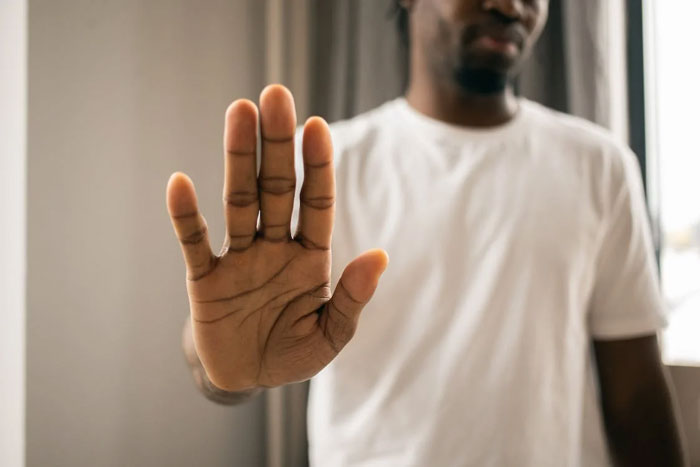
I just hold up both my hands (like Stop) and say I am not a hugger. Love ya, byeeeeee lol
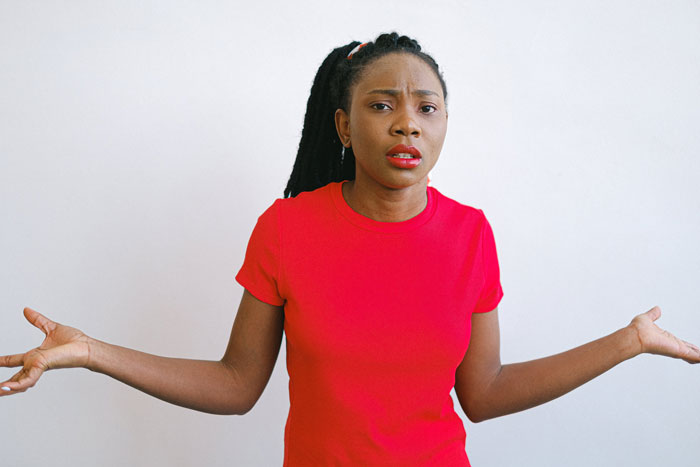 Not all phrases are for all situations or for all people. In my experience working with a majority of white clients in the Midwest to Rocky Mountain area of the United States, about 70% of people, when they're confronted with someone saying something racist, fatphobic, homophobic, or just problematic in general, just don't say anything because they don't know what to say. Having a phrase like "Hmm. What an odd thing to say out loud?" is better than saying nothing! If you're someone who's already comfortable asserting your boundaries, your reaction to this is, "Oh, that's really passive! Just tell them to f- off!" or whatever, this is not the phrase for you! Like I said, not all phrases are for all people or all situations.

"What an odd thing to say out loud". I love this, buried in the paragraph of explanation.
I’ve noticed that calling something weird or rude can be more effective than calling it X-ist because these people don’t care about minorities but do care about being seen as normal and a good person.
The white fragility annoys me - and I'm white. One of those delicate folks told me that I should have used the phrase "What do you mean?" so that they could explain it. Lesson learned, but too late to save the friendship as I'd had it up to here with them treating me like a safe space for bigots.
Load More Replies... As a white person from this same part of the world I can confirm here. The frequency of unhinged comments like this boggle my mind. I like to give responses that imply I have no idea what they are talking about (because they are almost always dog-whistle comments) and then just sit there quietly while they awkwardly try to dance around it. "What do I think apartment buildings bring to the area" they might ask? "Poor people? People without a need for space and a yard? Location?" I might answer.....defiantly not the answer they were looking for.

I’m am a big fan of “What an odd thing to say” and its sibling “what a strange question” and find those two phrases are all I need to shut down any sort of intrusive, insulting or irritating conversation. Either can be said brightly with a good-natured chuckle, in feigned shock, derisively, in mock concern or with the utmost earnestness depending on the situation.
I find that "excuse you?" also works. It lets people know they said/did something that wasn't okay, and you're giving them one last chance to unf*ck themselves.
The mother of one of my students just says "Not necessarily!"
Load More Replies...
You can change "odd" to "racist" "homophobic" "bigoted" "judgemental" to call them out and make them aware that you are what they are doing and it's not ok. (And in some very white areas, people may be so used to hearing and saying certain things that they don't even connect that what they said is wrong, especially if nobody calls them out on it, so it can be a teachable moment too)
I had a roommate once when I lived in a house that grew to have about 8 people in it, she said "I think you and I are thr only ones here who were born in this country" and I literally said that in response "wow, what an odd observation to make".
Material boundaries are also a big deal. This is all about your finances and possessions. Here, you might consider whether lending money is an option for you and, if it is, how much and to whom you are comfortable giving. But that’s not all. Deciding whether you want to lend someone your books or your car is also a part of it, so is putting a cap on how much you are willing to spend on a trip or an outing.
 Sometimes people ask questions because they're curious, and they're not questions that I'm going to answer. So, I just say, "Oh, I'm not going to answer questions about that."

Whenever someone says to me, "Can I ask you a question," I always reply, "Of course you can, I'm not guaranteeing I'll answer it, but you can certainly ask."
 If someone is being inappropriate, you could directly say, "Hey! This is not a safe space for your bigotry. Knock it off!" Or, you could indirectly say, "Oh. We are not on the same side with this." Don't stay silent. SAY THE THING!
That is far too polite for someone being inappropriate. Just say, “Please stop.”

Disagree. One can set a boundary much better than that. I have said "I am not the right audience for this" and variations and it always works." Please stop" invites offense and argument.
Load More Replies...
 "I'm not going to make a decision about that right now. Let me think about it, and I'll get back to you!" or "I'm not going to make a decision about that right now. I need to think about it. Will you please check back with me?" Sometimes people ask questions that I'm not ready to make a decision about, and I'll think about it and get back to them.

When I'm angry about something and likely to say something I'll regret later or I know I'm going to be volatile I say 'I need up to 72 hours to think about this before I can respond appropriately.' I find taking that kind of time helps me to look at things from multiple perspectives and gives me a chance to form an intelligent and well received response. If I'm still pissed off 72 hours later I figure that person deserves what ever type of explosion I produce!!
Or “What do you mean by that? I don’t understand”. Makes them explain their racism/misogyny/homophobia/etc in detail, thereby showing them up for the miserable rotten piece of s**t they actually are.
Load More Replies... If they're in a hurry, make sure that they know that "NO! And go p**s off." is available immediately.
My coworker had severe anger towards a manager (who I didn't like either so I understood) and when manager said "hey I'm still kinda like sensing a bad mood from you?" the coworker said "yeah, I'm still angry, and I'm not ready to discuss it yet because I don't want to say anything I'm going to regret."
Then, there are time boundaries as well. Setting them should prevent you from overcommitting and feeling drained. To do so, you have to identify your priorities (career, family time, relationship) and let them guide you when making decisions. If your priority is spending time with family, you might want to say no to taking on extra hours at work. It is also important to prioritize yourself once in a while, and say “no” to things simply because you need some me-time.
 "I don't need help with this. I've got it!" One of my friends uses crutches as a mobility aid, and all the time people will come up and try to take stuff out of their hands to be helpful. They have good intentions, but if you grab something from someone on crutches, it often unbalances them and increases the risk of falling! which is very dangerous. A phrase like, "Oh, I don't need help with this. I've got it!" is good for those types of situations. Or any other time people intend to be helpful, but their help is not helping. And you can say, "Oh, I don't need help with this. I've got it!"
Happened a few weeks ago at the physiotherapist's. A woman, strongly impaired, with two crutches, trying to open a heavy door. I moved towards her, stopped and asked 'may I help you?' and she declined, because she needed to get used to do these things alone. Both of us were fine.

Disability (whether temporary or permanent) awareness really and truly needs to be taught in schools and society - by people who are themselves disabled and understand the issues. We nearly had an elderly woman who used a walker fall headlong into our tiled entryway at our practice, all because someone who thought he was being helpful pulled the door open for her. What he did not pay attention to was that she had the walker to one side, and was leaning on/gripping the door handle for balance as she pushed it open. I was horrified, it happened so fast. I’ve seen situations where people don’t pay attention and kick someone’s cane out from under them because they are in a hurry, knock someone with a walking aid down the stairs while pushing past them with their child, smack wheelchair users in the face with bags,, push people in wheelchairs as if they were in-the-way luggage, kids run in front them, people try to squeeze past them (in motion), kids grabbing wheels. Horrifying.
I always overthink this sort of situation. So when I made a new friend who's visually impaired, I came right out and asked if there was anything I needed to be sure not to do. It sounds like I'm putting my problem on her, but I figure she's the expert here.

As the parent of a person with special needs, I really appreciate this approach. There are things I alone need to do for my son, things he is learning to do by himself (that usually take longer and/or are awkwardly done), and things I might need help with. The best way someone can help is by asking if/what kind of help is needed.
Load More Replies... My husband is a "helper" and I have had to explain to him that it could be seen as insulting and he needs to ask first. Meanwhile I'm over in a corner not talking to strangers lol
When I see someone using an electric shopping cart, I always ask if they need help to reach an item. Some are able to stand up and get the item themselves, so I don't assume.
 If someone tries to push your wheelchair without asking first you can say, "Hey! Please don't touch my wheelchair" or "How would you like if I moved your legs around without asking you huh? I could move you around like a little action figure but that wouldn't be very cool, would it?"

Better yet: "Take your hands off of me or I'm calling the police!" If you start pushing someone who uses a manual wheelchair without asking or being asked, it's ASSAULT. Mobility aids are a part of the person who uses them, and there is no difference between coming up behind a stranger who's walking, grabbing them by the shoulders, and pushing them forward and coming up behind a stranger using a manual wheelchair, grabbing the wheelchair's push handles, and pushing them. Both are assault.
I agree. And the consequences could be devastating. If they're not currently moving, they might have their hands relaxed like the photo. In which case, you abruptly moving them could damage their fingers and take away their means of mobility.
Load More Replies...
Honestly, if you see a person using a manual wheelchair and they're alone, they're most likely able to ask for help if they need it. People with disabilities (PWDs) who use wheelchairs for mobility generally don't go out alone if they're unable to manage where they're going alone. Don't assume PWD in wheelchair = must need help. Just go about your day and allow them to go about their's, secure in the knowledge if they 𝗱𝗼 need help and ask you for it, you'll be happy to provide it.
Load More Replies...  THEM: "Have you recently gained weight?"
ME: "I only discussed that with my doctor. Let's talk about something else!"
I only discuss my weigth with my doctor. I only discuss my health with my doctor. I only discuss my body with my doctor or with my partners or my very best friends. This is not a topic I'm going to get into with nosy people! If people are being nosy about your weight, your health, your body, whatever, you can say, "Oh! I only discuss that with my doctor. Let's talk about something else!" and change the subject.
THEM: "Have you recently gained weight?"
ME: "I only discussed that with my doctor. Let's talk about something else!"
I only discuss my weigth with my doctor. I only discuss my health with my doctor. I only discuss my body with my doctor or with my partners or my very best friends. This is not a topic I'm going to get into with nosy people! If people are being nosy about your weight, your health, your body, whatever, you can say, "Oh! I only discuss that with my doctor. Let's talk about something else!" and change the subject.
Whenever my grandma heard a question like that she'd just say "No. But I see you've lost your mind."
Load More Replies... It used to be semi-ok to compliment friends on their weight loss. Then came Aids.
Just change the subject. If someone asks that, it’s usually family. If someone who isn’t family asks that question? About face and walk away. ☢️
You are ALLOWED to just change the subject but no one else is OBLIGATED to. Do you see the difference?
Load More Replies...
I don't think it is always a bad question. If you always have been on the slim side and you gained 10 pounds I would be worried if their health was oké. Gaining wehight can be a sign of a serious illness It also depends on how the question is asked, in what tone.
But people who ask are usually just rude.
Load More Replies... I've started to give out my weight in hexadecimal. I went from 256 to 100 without dieting.
Note that not all boundaries are always set in stone. Sometimes we push our own boundaries and that’s not necessarily a bad thing. For example, you might not feel like sharing your relationship woes with a person you just recently met. But, once you have established trust, you might feel like opening up. To know whether it’s the right move, try to listen to your gut. If sharing feels comfortable—go for it.
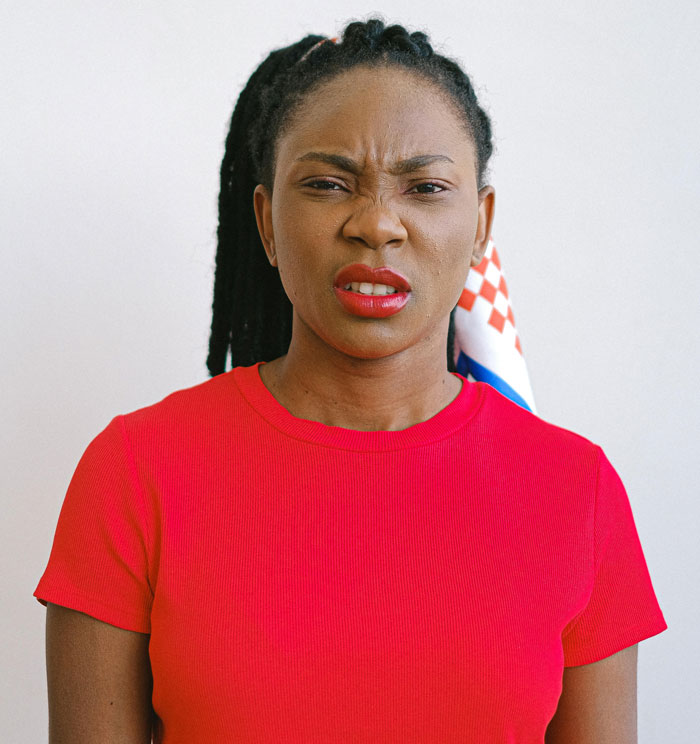 "Oh! That is a really inappropriate thing to say!" Notice how it changes when I change the disruptor. "Yikes! That's an inappropriate thing to say!" A disruptor is an exclamation, statement, or noise that stops what's happening. They're useful when you're setting boundaries, typically with strangers or people you're not very emotionally close with, and you need them to pause and stop whatever is going on.

 I could directly say, "Hey! That's not okay! Please don't do that here." Or I could indirectly say, "I would appreciate it if you didn't do that again." Some people are more comfortable with direct, and some people are more comfortable with indirect.
“Do you REALLY have no idea just how stupid you look doing that?” Do you REALLY have no idea just how much of an a*****e you sound like saying things like that?” “You know, that’s NOT the flex you seem to think it is”. Those have worked for me. People who say or do the inappropriate are generally too stupid to come up with any kind of smart—-or smart a*s—-comeback when you call them out like that.

 So, I'm existing as a fat person trying to sit down in my assigned and paid-for seat at this event, and it's right next to this masculine presenting person who's like limbs akimbo, right? Arms spread out, legs spread out; they were taking up all the space. In that moment, I had a couple of options. I could directly say, "Oh! I need more space than that. Will you please scoot over?" Or I could indirectly say, "Oh! I don't know if we're both gonna fit!" Because I have just as much right to put my beautiful fat body in that space that I paid for and was assigned as they do!
That's not just a fat thing, manspreaders's legs typically take up enough space for 2-4 thin people!
I encountered my worst manspreader when I was about the thinnest I’ve ever been, so I second this and offer solidarity with manspreading recipients of all sizes. Although I’m sure manspreaders use fat people’s size as an excuse, so extra solidarity to people like OP!
Load More Replies... Once I sit my not-skinny-at-all tush down, they have to move over a bit anyway! 🤣
That second one opens a window for a rude response from him.i just sit and take my space back without hesitating. If I get a nasty look I give a momentary scrunched up face back and put my leg up against theirs if they don’t give me my space. Don’t be shy. Theyre already disrespecting you.
Actually, you had a third option...stepping on his foot, then saying, "Oh, dear! I'm so sorry, but it seems your foot was in the space I paid for. If you'd be so kind as to keep to the space you paid for, I'm sure we'd both be much more comfortable."
I have hung my handbag on their leg before. It usually freaks them out, which makes their balls magically shrivel to normal size in the blink of an eye.
All in all, there are a lot of situations where drawing a line is very important. Being able to do so with one quick phrase can really help you feel more confident in your decision. So, memorize the phrases in this list that suit you and your life. Maybe next time you are stumped by a nosy question, you won’t be lost for words.
 "I see your message, and I'll respond more later when I have time to give you my full attention." I actually have this one programmed into my phone. I can just type a couple letters, and it auto fills this. Because sometimes people message me things that I'm like, "Oh! I see this. I am acknowledging that I saw this." Especially if they're sharing something personal, vulnerable, or whatever, but I'm not in the right headspace to respond fully at that time. Then I get back to them later. One of the things I do to make sure I get back to them later is go back in and mark that message as "unread" so it shows up in my notifications so I don't forget!
 If someone wants to shake your hand, especially at work, but you don't want to, you can directly say, "Oh, I don't shake hands. I'm excited to be here! Let's get this meeting started, shall we?" Or you can indirectly say, "I prefer just a friendly wave. It's a germ thing! Should we get started?"
These days, you can offer an elbow or fist to bump and people won't think it's all that strange.

We usually fist bump at my workplace, I love it. Before covid in france women were expected to kiss people even in the workplace sometimes and it was an absolute nightmare to me. Since covid slowed down some ppl tried to bring the old habits back. I usually go with "There is no going back, fist bump!"
Load More Replies... Hand shaking is pretty useless in the modern world. Just like ties. Both are means of control and subordination.
I'm not big on shaking hands, but I've never encountered its use to control and subdue others. Then again, a big guy would look kind of stupid crushing the hand of a 4'11" nobody. On the other hand, actor Jon Hamm recounted how Donald Trump shook his hand so as to get him off-balance (didn't work).
Load More Replies... There's no way out of this. If anyone sticks a paw at you, they're going to be miffed if you don't take it
It is taken as a deliberate public insult. And of course sometimes it is.
Load More Replies...
Hand shakes and the threat of one coming my way make me feel an awful constricting pain in my chest and stomach. Actual pain. I don't like. It must show because then the actual handshake I'm forced to do goes very awkwardly. I wish we could just say our names and nod at each other or a little tiny wave instead. Doesn't go down well in finance though unfortunately.

You're assuming I would care about the estimation of people who don't care about my boundaries.
Load More Replies...
Very helpful. For those of us who were raised by parents who had poor boundaries, it's good to have some go-to scripts we can memorize. I even practice boundary statements in the mirror sometimes, to get more comfortable with them. However, another thing I've had to work on is dealing with the push-back from people who don't like my boundary statements, no matter how gently I state them. People who guilt-trip, ignore, or become downright aggressive in response. I've had to work on my automatic feelings of guilt and learn to hold to my boundaries.
I'm in the same boat. I wasn't taught boundaries and how to keep myself safe. I'm now learning to stand up for myself and not just catow to what's happening around me.
Load More Replies...
I find these a bit cumbersome and even naive. Probably a linguistic/cultural thing. In some cultures it's considered OK to just say "No", "Sorry I'm busy", "Wait!" or even "Get out of my face".
My husband came from a more "polite" background and dated someone from a very direct culture. It was a bit much for him and she thought some of the people around him were a bit wimpy.
Load More Replies... Only about five of these were helpful. The rest? Just common sense, really…
I thought the first one was good. The rest were just... meh. Kinda dumb.
Load More Replies...
A lot of "please" going on. A lot of appeasing language. In my experience, if someone has already ovestepped a boundary, words like "please do not" and "I would appreciate it if" will not make them back off. With such phrasings you sound like you are asking them a favour. Why should they! They have already shown that they don't care about what you want.
Keeping some of these in mind for Christmas with my family, along with "I don't get it. Can you tell me why you find that [racist/sexist joke] funny?"
Why do so many of the suggested phrases begin with "Oh!" and end with an exclamation point? Are their effectiveness diminished if the "Oh!" at the beginning and exclamation point at the end are omitted? If so, why?
Very helpful. For those of us who were raised by parents who had poor boundaries, it's good to have some go-to scripts we can memorize. I even practice boundary statements in the mirror sometimes, to get more comfortable with them. However, another thing I've had to work on is dealing with the push-back from people who don't like my boundary statements, no matter how gently I state them. People who guilt-trip, ignore, or become downright aggressive in response. I've had to work on my automatic feelings of guilt and learn to hold to my boundaries.
I'm in the same boat. I wasn't taught boundaries and how to keep myself safe. I'm now learning to stand up for myself and not just catow to what's happening around me.
Load More Replies... I find these a bit cumbersome and even naive. Probably a linguistic/cultural thing. In some cultures it's considered OK to just say "No", "Sorry I'm busy", "Wait!" or even "Get out of my face".
My husband came from a more "polite" background and dated someone from a very direct culture. It was a bit much for him and she thought some of the people around him were a bit wimpy.
Load More Replies... Only about five of these were helpful. The rest? Just common sense, really…
I thought the first one was good. The rest were just... meh. Kinda dumb.
Load More Replies... A lot of "please" going on. A lot of appeasing language. In my experience, if someone has already ovestepped a boundary, words like "please do not" and "I would appreciate it if" will not make them back off. With such phrasings you sound like you are asking them a favour. Why should they! They have already shown that they don't care about what you want.
Keeping some of these in mind for Christmas with my family, along with "I don't get it. Can you tell me why you find that [racist/sexist joke] funny?"
Why do so many of the suggested phrases begin with "Oh!" and end with an exclamation point? Are their effectiveness diminished if the "Oh!" at the beginning and exclamation point at the end are omitted? If so, why?










 No fees, cancel anytime
 then open in external browser


 and click "Open in External Browser"